All posts
Insights

Vikram Das

The FinOps Foundation's framework, the industry standard for cloud financial management, was designed for enterprises with dedicated FinOps teams, executive sponsors, and cross-functional working groups. For a 50-person company spending $200K–$500K monthly on cloud, that framework is aspirational, not practical. You need a FinOps culture that matches your scale and intent. Here is how to build a functional FinOps culture without hiring a single FinOps specialist.
The SMB FinOps Problem
Small and mid-sized companies face a specific set of cloud cost challenges that differ from enterprise problems. Engineering teams are small and generalist. Everyone wears multiple hats. The idea of dedicating anyone full-time to cloud cost management is impractical when you barely have enough engineers to ship features.
Finance teams are similarly lean. The person reviewing cloud bills might be the CFO, the CEO, or a part-time bookkeeper. They see the total number but lack the technical context to understand why it is what it is or what to do about it.
The result is a gap: engineering does not prioritize cost optimization because it is not their primary job, and finance cannot drive optimization because they do not understand the technical levers.
Principle 1: Shared Ownership, Not Dedicated Ownership
Instead of hiring a FinOps specialist, distribute cost responsibility across existing roles. The engineering lead owns weekly cost review (30 minutes per week), development team leads own cost attribution for their services, the finance lead or CEO owns budget setting and variance analysis, and the platform or DevOps engineer owns tooling and automation.
No single person spends more than an hour per week on cost management. In aggregate, the company invests 3–4 hours per week — the equivalent of a fraction of a full-time hire — while maintaining cost discipline.
Principle 2: Automate the Operational Work
The reason enterprise FinOps requires dedicated headcount is the volume of operational work: analyzing recommendations, prioritizing actions, coordinating with teams, tracking execution, and reporting results. At an SMB, this work must be automated to be sustainable.
Automated weekly cost reports should go to engineering leads and finance, showing spend by service, week-over-week change, and top cost drivers. Automated anomaly detection should alert when daily spend deviates significantly from the trailing average. Automated optimization should handle low-risk actions like zombie resource cleanup and development environment scheduling without human intervention. AI-driven rightsizing should generate and execute recommendations for non-production environments automatically, with human approval required only for production changes.
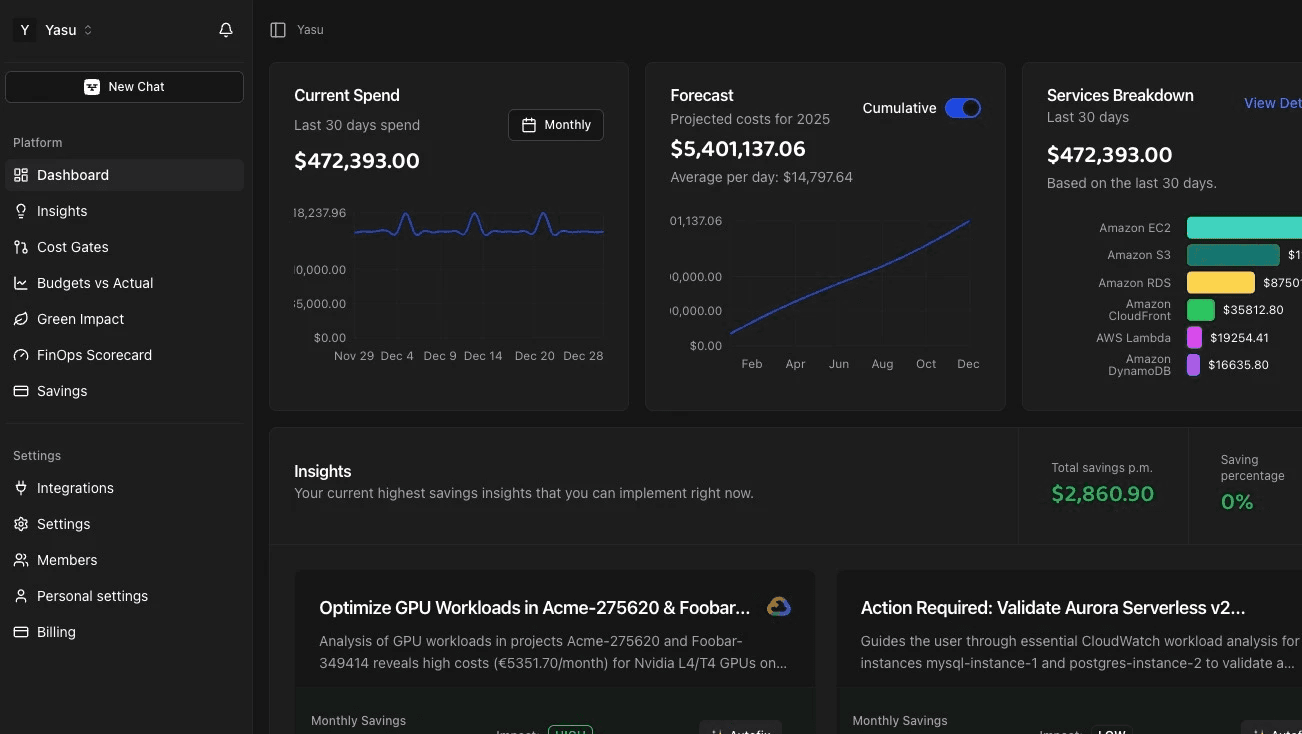
This is where AI-powered platforms deliver disproportionate value for smaller companies. A platform like Yasu replaces the operational work that would otherwise require 1–2 full-time FinOps practitioners, making enterprise-grade optimization accessible at SMB budgets.
Principle 3: Embed Cost in Engineering Workflows
Cost should not be a separate conversation. It should be embedded in the places engineers already work: pull requests, sprint planning, and architecture reviews.
In pull requests, add cost annotations for infrastructure-as-code changes so developers see the cost implication of their changes alongside code review feedback. In sprint planning, include cloud cost impact as a consideration when prioritizing infrastructure changes. In architecture reviews, require cost projections for any new service or significant infrastructure change.
The goal is to make cost awareness a natural part of engineering decision-making, not an additional process bolt-on.
Principle 4: Focus on Unit Economics, Not Total Spend
Total cloud spend going up is not inherently bad — it often means the business is growing. The metric that matters is cost per unit of business value: cost per customer, cost per transaction, cost per active user.
At an SMB, track one or two of these metrics weekly. If cost per customer is decreasing or stable as you grow, your cloud infrastructure is scaling efficiently. If it is increasing, you have an optimization opportunity or an architectural issue worth investigating.
This reframing is powerful because it aligns engineering and finance around a shared metric that both can understand and influence. Finance cares about the ratio because it affects margins. Engineering cares because it reflects the efficiency of their systems.
Principle 5: Start Small and Iterate
Do not try to implement a complete FinOps framework in a quarter. Start with three things: tag all resources by team or service (week 1), set up automated weekly cost reports (week 2), and implement one automated optimization (zombie cleanup or scheduling) (week 3). These three steps take less than a day of engineering time and establish the foundation for everything else. Add more sophisticated practices like shift-left cost prevention, commitment optimization, and rightsizing in subsequent quarters.
The 30-Minute Weekly Cost Review
The most important ritual for a lean FinOps culture is a 30-minute weekly cost review. The engineering lead reviews the automated cost report, identifies any anomalies or unexpected changes, assigns investigation to the relevant team lead if needed, and updates the cost trend tracking.
This 30-minute ritual prevents the most common SMB failure mode: nobody looks at cloud costs until the quarterly review reveals three months of accumulated waste.
Frequently Asked Questions
Can a small company do FinOps without a dedicated team?
Yes. FinOps at an SMB is about distributed ownership and automation, not dedicated headcount. By embedding cost awareness into existing engineering workflows and using AI-powered automation for operational optimization, companies as small as 20 people can maintain effective cloud cost management.
How much time should a small team spend on cloud cost management?
Target 3–4 hours per week distributed across the team: 30 minutes for a weekly cost review by the engineering lead, plus 30–60 minutes per team lead for cost-aware decision making in their normal workflow. AI automation handles the rest.
What is the minimum cloud spend to justify cost optimization?
Any company spending more than €5,000 per month on cloud should have basic cost optimization practices in place. At that level, even a 15% improvement saves €9,000 per year — more than enough to justify the minimal time investment.
What is the first thing a small team should do for FinOps?
Tag all cloud resources by team or service. Without attribution, you cannot hold anyone accountable for costs, and you cannot identify which workloads are driving spend growth.
Do I need expensive FinOps tools?
No. Start with your cloud provider's native cost management tools (AWS Cost Explorer, GCP Billing Reports, Azure Cost Management). Add an AI-powered optimization platform when you are ready to automate optimization execution rather than just monitor costs.
How do I get engineers to care about cloud costs?
Embed cost information into their existing workflow (PR cost annotations, sprint planning cost discussions) rather than creating a separate process. Make cost data visible and actionable, and celebrate wins when teams reduce costs.