All posts
Insights

Vikram Das

Every organization that takes cloud cost optimization seriously goes through the same evolution. It starts with someone getting a shocking bill and asking "what are we even paying for?" It ends—ideally—with automated systems that continuously optimize spending without human intervention. But the journey between those two points is where most organizations get stuck, usually because they try to jump from basic visibility straight to automation without building the operational foundation that makes automation reliable rather than dangerous. Here's a framework for understanding where you are, what each stage looks like in practice, and why skipping stages usually breaks when workloads change.
Stage 1: Reactive — "Why Is the Bill So High?"
Every cloud cost journey begins here. An executive sees a cloud bill that's higher than expected and asks engineering to explain it. The team scrambles to figure out where the money went, usually by logging into each cloud provider's billing console and manually investigating the largest line items.
Characteristics of Stage 1 organizations include no consistent cost allocation or tagging, no regular cost review process, costs discovered through billing surprises rather than proactive monitoring, optimization happening only in response to budget overruns, and no dedicated ownership of cloud costs.
The biggest risk at this stage is that cost overruns trigger reactive cuts that impact performance and reliability. Without visibility into what's wasteful versus what's essential, teams make cuts based on size rather than value, potentially affecting critical production services.
To move beyond Stage 1, you need to establish basic cost visibility: connect your cloud accounts to a cost management tool, implement a minimum viable tagging strategy, and designate someone (even part-time) as the cost owner.
Stage 2: Informed — "We Can See Where Money Goes"
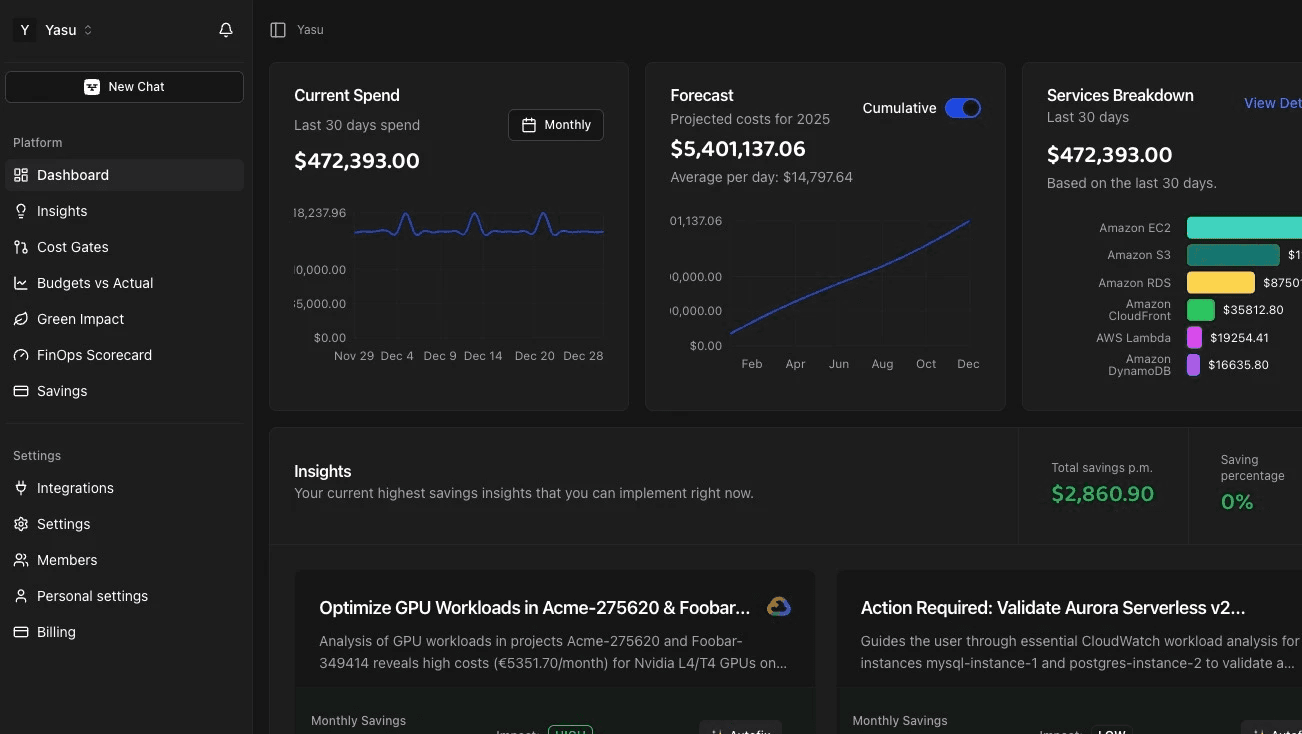
At Stage 2, the organization has basic cost visibility. Dashboards show spending by service, team, or environment. Monthly or weekly cost reports exist. Someone can answer the question "what are our top 10 cost drivers?" without logging into the cloud console.
Characteristics of Stage 2 include cost dashboards and regular reporting, basic tagging strategy implemented on most resources, monthly cost review meetings with stakeholders, cost allocation to teams or business units, and manual identification of optimization opportunities.
The limitation of Stage 2 is that visibility without action creates what FinOps practitioners call "dashboard fatigue." Teams can see the waste, but implementing optimizations requires manual effort that competes with feature development for engineering bandwidth. Cost reports become routine background noise rather than catalysts for action.
To move beyond Stage 2, shift from reporting to recommendations: implement tools that don't just show spending but suggest specific optimization actions with estimated savings.
Stage 3: Optimizing — "We Have a Process for Reducing Waste"
Stage 3 organizations have moved from visibility to action. They have regular optimization workflows: rightsizing reviews, commitment purchase cycles, idle resource cleanup sprints, and storage optimization projects.
Characteristics of Stage 3 include defined optimization workflows with regular cadence, rightsizing and commitment management processes, cost optimization targets set and tracked per team, FinOps function or working group established, and some automation for simple tasks like scheduling and alerts.
Stage 3 is where most organizations plateau. The optimization process works, but it's human-driven and therefore limited by human bandwidth. A FinOps team of 2-3 people can't possibly review every resource across a cloud estate of thousands of instances, hundreds of storage volumes, and dozens of Kubernetes clusters. They prioritize the biggest opportunities and leave the long tail of smaller optimizations untouched.
The result is a sawtooth pattern: costs decrease during optimization sprints, then creep back up as new unoptimized resources are provisioned between sprints. The organization is optimizing, but it's running on a treadmill.
To move beyond Stage 3, introduce automation for high-confidence optimizations: changes that the data clearly supports and that carry minimal risk, like cleaning up idle resources, adjusting non-production instance sizes, and managing commitment utilization.
Stage 4: Automated — "Optimization Happens Without Us"
At Stage 4, the organization has automated routine optimization tasks. Rightsizing recommendations for non-production environments are auto-applied. Commitment purchases are algorithmically optimized. Idle resources are automatically flagged and scheduled for termination. Auto-scaling configurations are tuned based on actual traffic patterns.
Characteristics of Stage 4 include automated implementation of high-confidence optimizations, policy-as-code enforcement for cost governance, automated commitment management and purchasing, continuous optimization rather than periodic reviews, and human oversight focused on exceptions and strategic decisions.
The key shift at Stage 4 is that the FinOps team moves from execution to governance. Instead of manually implementing optimizations, they define policies and guardrails, review edge cases, and focus on strategic decisions like commitment strategy and architectural cost optimization.
The limitation of Stage 4 is that automation rules are still relatively static. They work well for known patterns but can't adapt to novel situations or cross-domain optimizations that require understanding of application behavior, business context, and infrastructure interdependencies.
Stage 5: Autonomous — "AI Optimizes End-to-End"
Stage 5 is the frontier of cloud cost optimization. At this stage, AI agents understand your workload patterns, business context, and infrastructure relationships well enough to make optimization decisions that previously required human judgment.
Characteristics of Stage 5 include AI-driven optimization that adapts to changing patterns without rule updates, cross-domain optimization considering compute, storage, network, and application performance together, predictive optimization that acts before waste occurs rather than cleaning up after, continuous learning from optimization outcomes to improve future decisions, and human involvement only for strategic decisions and novel situations.
The difference between Stage 4 automation and Stage 5 autonomy is adaptability. Stage 4 automation follows rules: "if utilization is below 30% for 7 days, recommend a downsize." Stage 5 AI understands context: "this instance shows low utilization now, but it's Monday morning and this workload spikes every Tuesday through Thursday, so no action is needed."
Platforms like Yasu are building toward Stage 5 with agentic AI that continuously monitors, learns, and optimizes across the full cloud infrastructure stack. The agent architecture means the system doesn't just follow rules — it reasons about optimization opportunities, considers trade-offs, and makes decisions that account for the full context of your environment.
Assessing Your Current Stage
To determine your current maturity stage, answer these diagnostic questions.
Can you tell me your cloud spend by team within 5 minutes? If no, you're at Stage 1. If yes, you've reached at least Stage 2.
Do you have a regular process for implementing cost optimizations? If no, you're at Stage 2. If yes, you've reached at least Stage 3.
Do optimizations happen automatically without someone triggering them? If no, you're at Stage 3. If yes, you've reached at least Stage 4.
Does your optimization system adapt to new patterns without rule changes? If no, you're at Stage 4. If yes, you've reached Stage 5.
Common Mistakes When Advancing Maturity
The most common mistake is trying to skip stages. Organizations at Stage 1 that buy an advanced automation platform often fail because they don't have the tagging, governance, and organizational buy-in that the platform needs to function effectively.
The second most common mistake is getting comfortable at Stage 3. The optimization process works well enough that there's no urgency to automate. Meanwhile, waste continues to accumulate in the long tail of resources that the human-led process doesn't reach.
The third mistake is treating maturity advancement as a tooling problem rather than an organizational one. Moving from Stage 3 to Stage 4 requires not just better tools, but cultural changes: engineering teams that trust automated optimization, governance frameworks that define what can be auto-optimized, and executive support for the investment in automation infrastructure.
The Business Case for Maturity Advancement
Each stage advancement delivers measurable value. Moving from Stage 1 to Stage 2 typically reduces waste by 10-15% through basic visibility and awareness. Moving from Stage 2 to Stage 3 adds another 10-15% through active optimization processes. Moving from Stage 3 to Stage 4 adds 5-10% from automation and continuous optimization. And moving from Stage 4 to Stage 5 adds 5-10% from AI-driven contextual optimization.
Cumulatively, the journey from Stage 1 to Stage 5 can reduce cloud waste from 30-35% to under 10% — representing a 20-25% reduction in total cloud spend.
Frequently Asked Questions
How long does it take to advance one maturity stage?
Moving from Stage 1 to Stage 2 typically takes 1-3 months (implementing visibility tooling and tagging). Stage 2 to Stage 3 takes 3-6 months (building processes and organizational habits). Stage 3 to Stage 4 takes 6-12 months (implementing and validating automation). Stage 4 to Stage 5 is an ongoing evolution as AI platforms become more capable.
Do I need a dedicated FinOps team to advance beyond Stage 2?
Not necessarily. Stage 3 can be achieved with part-time ownership (an engineer or engineering manager who dedicates 20-30% of their time to cost optimization). Stage 4 and beyond benefit from dedicated FinOps resources, though AI-powered platforms reduce the required headcount compared to manual approaches.
Can small companies reach Stage 4 or 5?
Absolutely. In fact, smaller companies often reach advanced stages faster because they have less organizational complexity and fewer legacy processes to change. A 30-person startup can go from Stage 1 to Stage 4 within 6 months by adopting an AI-powered platform like Yasu that handles the optimization automation out of the box.
What's the most important metric to track across all maturity stages?
Cloud waste ratio: identified waste divided by total cloud spend. This metric is meaningful at every stage and provides a consistent benchmark for improvement. Target below 25% at Stage 2, below 20% at Stage 3, below 15% at Stage 4, and below 10% at Stage 5.
Is Stage 5 actually achievable today?
Full Stage 5 autonomy across all optimization dimensions is still emerging. However, specific optimization domains — like rightsizing, commitment management, and idle resource cleanup — can operate at Stage 5 maturity today with platforms that use agentic AI. The trajectory is clear: each year, more optimization decisions can be safely delegated to AI.