All posts
Insights

Vikram Das

FinOps dashboards gave cloud teams something they desperately needed: visibility into what they were spending and where. But visibility alone has not solved the cloud waste problem. Despite widespread adoption of FinOps practices and tools, organizations still waste roughly a third of their cloud budgets year after year. AI agents — autonomous software that can detect, decide, and act on cost optimization opportunities — represent the next evolution.
The transition from dashboards to agents is not about replacing financial visibility. It is about closing the gap between seeing a problem and fixing it.
The Dashboard Fatigue Problem
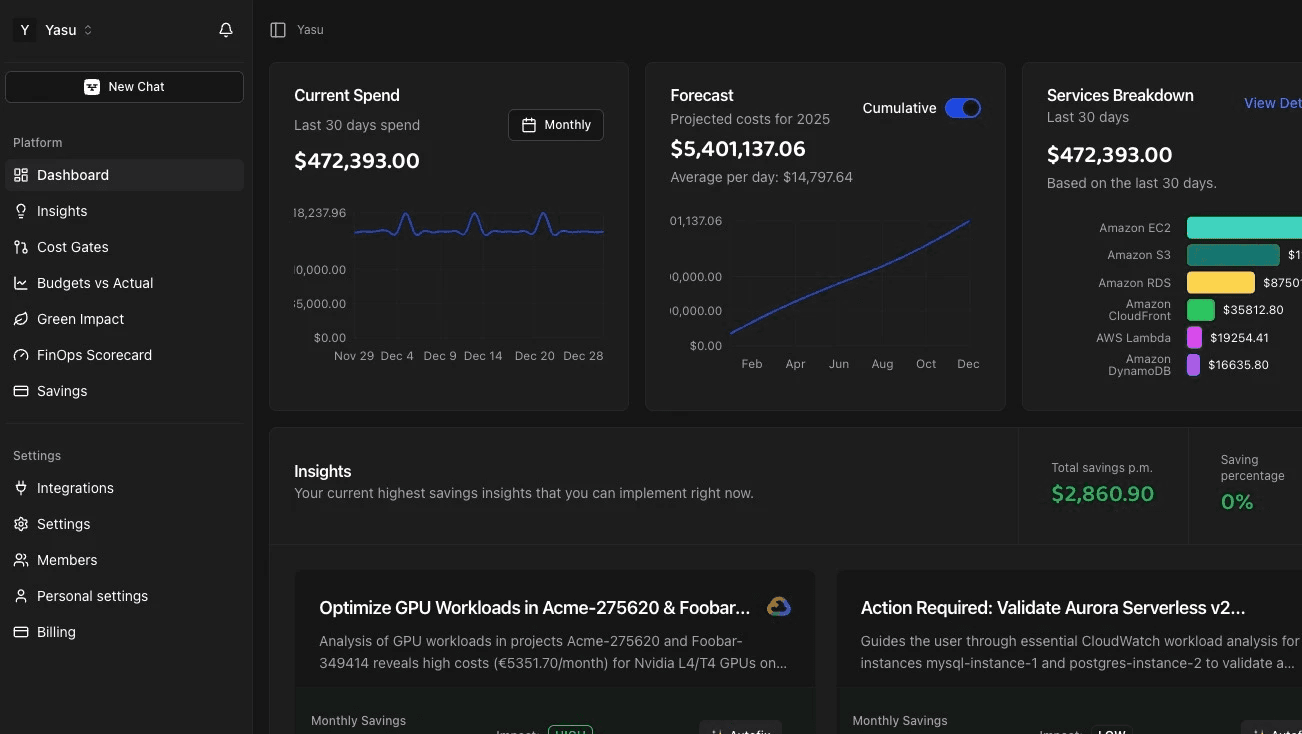
Every FinOps tool on the market does dashboards well. You can see your spend by service, by team, by tag, by hour. You can set budgets, configure alerts, and generate reports that make CFOs feel informed. The problem is what happens after the dashboard loads.
A typical cloud cost dashboard surfaces dozens of optimization recommendations at any given time. Right-size this instance. Delete that unattached volume. Switch to a reserved instance for this steady-state workload. Each recommendation is technically correct. But executing them requires context that the dashboard cannot provide.
Will rightsizing this instance affect the nightly data pipeline? Is anyone actually using that storage volume, or is it attached to a service that has been deprecated but not fully decommissioned? Does the team that owns this workload have the capacity to validate and deploy the change this sprint?
Engineering teams look at the dashboard, note the recommendations, add them to a backlog, and move on to higher-priority work. The recommendations grow stale. New waste accumulates. The cycle repeats.
This is not a tooling failure — it is an architecture problem. Dashboards were designed for humans to interpret. But humans are busy building products, not optimizing infrastructure.
What AI Agents Do Differently
AI agents operate on a fundamentally different model. Instead of presenting information and waiting for humans to act, they observe, reason, and execute within defined boundaries.
Contextual Understanding
An AI agent does not just see that an instance is running at 15% CPU utilization. It understands the workload pattern — this instance spikes to 80% every Tuesday during batch processing, and the last three months of data confirm this pattern is consistent. It knows the instance is part of a Terraform-managed infrastructure stack and that the workload is not latency-sensitive. With this context, the agent can confidently recommend or execute a rightsizing action that a static rule would either miss or get wrong.
Continuous Optimization
Dashboards are snapshots. Even real-time dashboards require someone to be watching. AI agents operate continuously, scanning for optimization opportunities 24/7. When a development team forgets to shut down a staging environment on Friday evening, the agent detects it within hours and can either terminate the resources or alert the team — rather than letting the waste accumulate until someone checks the dashboard on Monday.
Execution Capability
This is the fundamental shift. AI agents can act. They can modify instance types, adjust auto-scaling configurations, clean up orphaned resources, and update infrastructure-as-code definitions. The level of autonomy is configurable — from fully automated for low-risk changes in development environments, to human-in-the-loop for production workloads where approval is required before execution.
Learning and Adaptation
Unlike static rules that need manual tuning, AI agents learn from outcomes. If a rightsizing action causes a performance issue and gets rolled back, the agent incorporates this feedback into future decisions. Over time, the agent builds an increasingly accurate model of each workload's actual requirements.
The Shift-Left Advantage
Perhaps the most transformative capability of AI agents is operating earlier in the development lifecycle. Traditional FinOps dashboards can only analyze resources after they are deployed and running. AI agents integrated into CI/CD pipelines can evaluate infrastructure changes before deployment.
When a developer submits a pull request that provisions an oversized database instance, the AI agent can flag the cost implication in the PR review, suggest an appropriately sized alternative, and even provide a cost projection. This "shift-left" approach prevents waste from reaching production in the first place, which is 10x more cost-effective than detecting and remediating waste after deployment.
At Yasu, this is a core part of how we think about cloud cost optimization. Dashboards show you the fire after it is burning. AI agents help you prevent the fire from starting.
What This Means for FinOps Teams
The rise of AI agents does not eliminate the need for FinOps expertise. It elevates it. Instead of spending 60% of their time pulling reports and chasing engineering teams to act on recommendations, FinOps practitioners can focus on strategic work: negotiating committed use discounts, architecting cost-efficient deployment patterns, and aligning cloud spending with business outcomes.
AI agents handle the operational heavy lifting — the daily identification and remediation of waste. FinOps teams set the policies, define the guardrails, and focus on the decisions that require business context and organizational knowledge.
For smaller companies without dedicated FinOps teams, AI agents are even more impactful. They provide enterprise-grade optimization capabilities without requiring specialized headcount.
How to Evaluate AI Agent Platforms
When considering the move from dashboards to AI agents, look for platforms that demonstrate genuine agent capabilities rather than dashboards with an AI label.
The platform should show evidence of autonomous action, not just recommendations. It should integrate with your infrastructure-as-code tooling, not operate as a separate layer. It should provide clear audit trails of every action taken, with the ability to roll back. And it should offer configurable autonomy levels so you can start conservative and expand as trust builds.
Frequently Asked Questions
What is an AI agent in the context of cloud cost management?
An AI agent is autonomous software that continuously monitors cloud infrastructure, identifies cost optimization opportunities using machine learning, and can execute changes automatically within configurable safety boundaries — going beyond traditional dashboards that only display data and recommendations.
Will AI agents replace FinOps teams?
No. AI agents automate the operational work of identifying and executing cost optimizations, freeing FinOps practitioners to focus on strategy, policy, and business alignment. For organizations without dedicated FinOps teams, AI agents provide these capabilities without requiring specialized headcount.
How do AI agents ensure they do not break production systems?
AI agents use configurable safety controls including approval workflows for production changes, automatic rollback on performance degradation, change windows that respect maintenance schedules, and progressive rollout that tests changes on a subset of resources before full deployment.
Can AI agents work with infrastructure-as-code?
Yes. Advanced AI agent platforms integrate with Terraform, Pulumi, CloudFormation, and other IaC tools. This allows the agent to suggest or apply changes at the code level, ensuring optimizations persist across deployments and are tracked in version control.
What is the difference between AI recommendations and AI agents?
AI recommendations are suggestions presented on a dashboard for humans to evaluate and execute. AI agents go further by autonomously executing approved optimizations, learning from outcomes, and continuously adapting — closing the gap between identification and action that makes traditional recommendations ineffective.
How quickly do AI agents deliver results?
Most organizations see measurable cost reductions within the first week of deploying AI agents, starting with quick wins like orphaned resource cleanup and obvious over-provisioning. Deeper optimizations from learned usage patterns typically emerge within the first 30 days.