All posts
Insights

Vikram Das

Every cloud cost optimization platform promises savings. Vendors love throwing around impressive numbers—30% reduction here, millions saved there. But when you're the one making the business case to leadership, vague promises don't cut it. You need a framework for calculating actual return on investment, one that accounts for not just the tool's cost and the savings it generates, but the operational efficiency gains, the risk reduction, and the opportunity cost of not optimizing.
The ROI Formula
At its core, ROI for a cost optimization platform is straightforward:
ROI = (Total Value Delivered - Total Cost of Platform) / Total Cost of Platform
The challenge is accurately quantifying both sides of this equation. Let's break down each component.
Calculating Total Value Delivered
Direct Cloud Cost Savings
This is the most visible and easiest to measure value component. Direct savings come from rightsizing recommendations that get implemented, commitment optimization (better coverage, higher utilization), idle resource identification and cleanup, auto-scaling improvements that reduce over-provisioning, and storage optimization through tiering and lifecycle management.
To estimate potential savings before purchasing a platform, audit your current state. If you've never systematically optimized, expect 20-35% savings potential. If you have basic FinOps practices in place, expect 10-20% incremental savings from automation. If you're already optimizing actively, expect 5-15% additional savings from AI-powered optimization that finds opportunities humans miss.
For a company spending $50,000/month on cloud infrastructure with no current optimization, a platform delivering 25% savings would generate $12,500/month in direct savings.
Engineering Time Reclaimed
This is often the largest value component, yet it's the most frequently overlooked. Without an optimization platform, engineers spend significant time on cost-related tasks.
Manual rightsizing analysis typically takes 4-8 engineering hours per month per team. An organization with 5 engineering teams might spend 20-40 hours monthly on rightsizing — work that an AI platform can automate entirely.
Commitment management (analyzing usage patterns, purchasing reserved instances, monitoring utilization) requires 8-16 hours per month for a mid-size organization. This work requires specialized knowledge that's often concentrated in one or two people, creating a bottleneck.
Cost anomaly investigation (figuring out why the bill spiked, which team caused it, whether it's legitimate) consumes 4-10 hours per month depending on the frequency of anomalies.
Tag compliance auditing and enforcement might take another 4-8 hours monthly.
Total engineering time on cost management tasks: 40-70 hours per month for a mid-size organization. At a fully-loaded engineering cost of $100-$150/hour, that's $4,000-$10,500 in monthly engineering value that could be redirected to product development.
Optimization Velocity
Human-led optimization happens in cycles: analyze spending, generate recommendations, get approval, implement changes, wait for the next review cycle. This cycle typically runs monthly or quarterly, meaning waste accumulates between reviews.
AI-powered platforms optimize continuously. A recommendation generated on Monday can be implemented (or auto-implemented for high-confidence changes) by Tuesday, not held until the next quarterly review. The value of this velocity increase is the savings difference between continuous optimization and periodic optimization.
For most organizations, continuous optimization captures 30-50% more savings than monthly review cycles, simply because waste is eliminated faster and doesn't compound over weeks of inaction.
Risk Reduction and Governance
Automated cost governance prevents new waste from being created. Policy-as-code enforcement, automated tagging, and provisioning guardrails reduce the rate at which new waste enters the environment.
The value of prevention is harder to quantify but real: every over-provisioned instance that gets caught at deploy time saves months of unnecessary spending. Every untagged resource that gets flagged immediately prevents cost allocation headaches later.
Estimate prevention value as 10-20% of your annual optimization savings — representing waste that would have accumulated without automated governance.
Calculating Total Cost of Platform
Platform Subscription
Most cloud cost optimization platforms charge based on your managed cloud spend, typically 1-5% of optimized spending. A platform charging 3% on $50,000/month in managed spend costs $1,500/month.
Some platforms charge flat fees, per-resource fees, or savings-share models (they take a percentage of actual savings generated). Compare pricing models carefully against your specific situation.
Implementation Costs
Initial setup typically requires 20-40 hours of engineering time: connecting cloud accounts, configuring integrations, setting up policies, and validating initial recommendations. At $100-$150/hour, that's a one-time cost of $2,000-$6,000.
More complex implementations (multi-cloud, large Kubernetes environments, custom integrations) might require 60-100 hours.
Ongoing Maintenance
Ongoing platform management typically requires 2-5 hours per month: reviewing recommendations, adjusting policies, handling escalations, and staying current with platform updates. This is significantly less than the 40-70 hours of manual cost management it replaces.
Putting It Together: A Sample ROI Calculation
Let's work through a concrete example for a company spending $75,000/month on cloud infrastructure.
Annual value delivered: direct cloud savings of 25% at $225,000, engineering time reclaimed at 50 hours per month at $125 per hour giving $75,000, optimization velocity improvement at 35% more captured savings giving $78,750, and governance and prevention value at 15% of savings giving $33,750. Total annual value: $412,500.
Annual cost of platform: subscription at 3% of spend is $27,000, implementation one-time at 40 hours times $125 is $5,000, and ongoing maintenance at 4 hours per month times $125 per hour gives $6,000. Total annual cost: $38,000.
ROI: ($412,500 - $38,000) / $38,000 = 986%, or roughly 10x return on investment.
Payback period: $38,000 / ($412,500 / 12) = 1.1 months.
Even if you cut the estimated savings in half to be conservative, the ROI remains compelling: roughly 5x return with a 2-month payback period.
Common ROI Calculation Mistakes
Ignoring Engineering Time Value
The most common mistake is evaluating a platform purely on direct cloud savings versus platform cost. This ignores the 40-70 hours of monthly engineering time that gets reclaimed — often worth more than the direct savings.
Using Gross Savings Instead of Net
Some savings exist regardless of the platform: you'd eventually find and fix the most egregious waste manually. The platform's value is the incremental savings above what you'd achieve without it. However, the time acceleration factor means even "obvious" savings have significant value when captured immediately rather than months later.
Overlooking Avoided Costs
A platform that prevents over-provisioning at deploy time generates value that never shows up in savings reports because the waste never occurred. This prevention value is real but invisible in simple before/after comparisons.
Assuming Linear Scaling
Cloud environments grow over time, and waste grows proportionally. A platform that saves 25% today will save 25% of a larger number next year. Factor in expected cloud growth when projecting multi-year ROI.
Questions to Ask During Evaluation
When evaluating specific platforms, ask how they measure and report savings (realized savings versus projected savings), what the typical implementation timeline is from contract signing to first optimization, whether they offer a proof-of-value or pilot period where you can measure actual results, how they handle the transition from recommendations to automated implementation, and what their customers' average time to payback is.
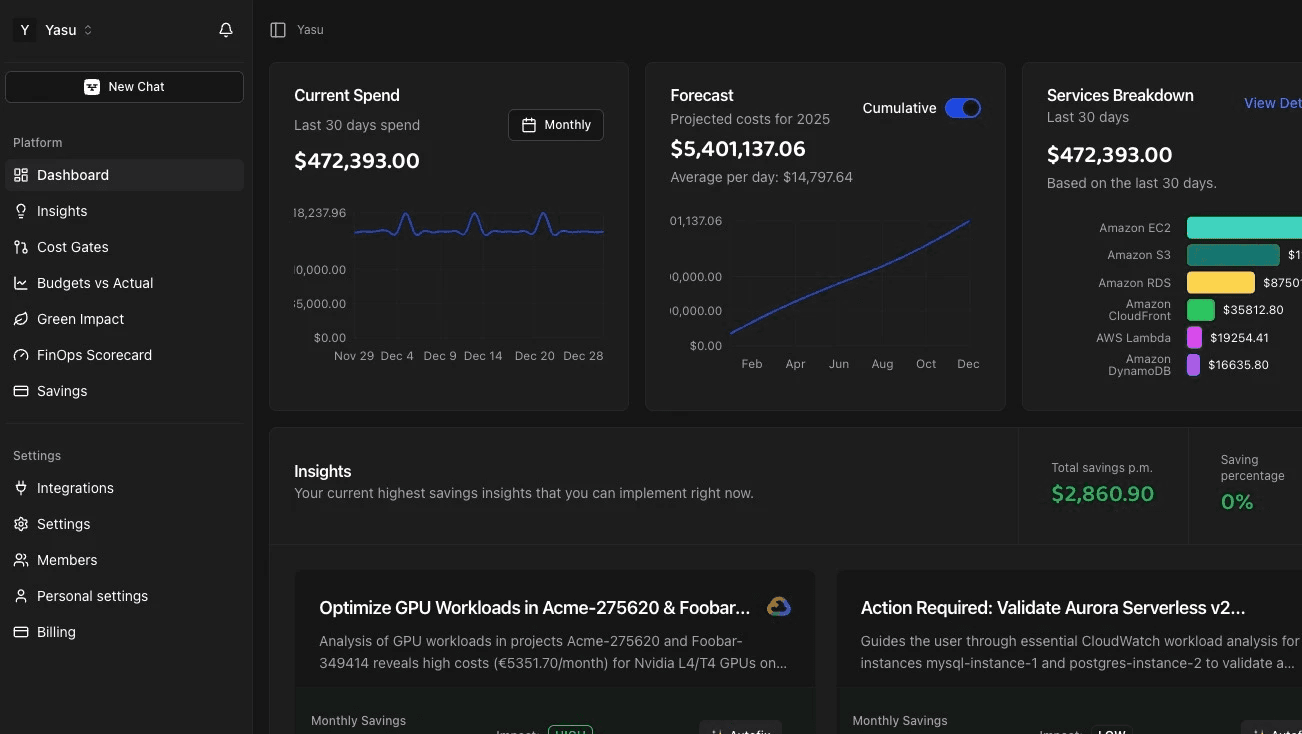
Platforms like Yasu that take an AI-native, agentic approach tend to deliver faster time to value because the automation begins working immediately after connection, rather than requiring lengthy configuration and manual review cycles. The ROI advantage of autonomous optimization over recommendation-only platforms compounds over time.
Frequently Asked Questions
What's a good ROI threshold for investing in a cost optimization platform?
Most organizations consider a 3x ROI with a 6-month payback period as the minimum threshold for infrastructure tooling investments. Well-implemented cloud cost optimization platforms typically deliver 5-10x ROI with 1-3 month payback periods, making them among the highest-ROI infrastructure investments available.
How do I justify the investment when we already have a FinOps team?
A cost optimization platform doesn't replace your FinOps team — it amplifies them. Instead of spending time on repetitive analysis and manual implementation, your FinOps team can focus on strategy, governance, and cross-organizational cost culture. The platform handles the execution at a speed and scale that manual processes can't match.
Should I wait until my cloud spend is higher to invest in optimization?
No. The percentage savings are consistent regardless of spend level, and starting optimization early prevents waste from compounding. A company spending $20,000/month can still save $5,000-$7,000 monthly with a platform costing $600-$1,000. The ROI math works at nearly any spend level above $10,000/month.
How do I measure the platform's impact after implementation?
Track these metrics monthly: total cloud spend trend, waste ratio (identified waste divided by total spend), optimization implementation rate, engineering hours spent on cost management, and cost per unit of business output. Compare these metrics to your pre-platform baseline and adjust for organic growth to isolate the platform's impact.
What if the platform doesn't deliver the expected savings?
Most reputable platforms offer pilot periods or money-back guarantees. During evaluation, insist on a proof-of-value phase where the platform connects to your environment, identifies optimization opportunities, and quantifies potential savings before you commit to a long-term contract.