All posts
Insights

Vikram Das
Forecasting traditional cloud costs is hard enough. Forecasting AI cloud costs feels nearly impossible. Your training costs depend on how many experiments your ML team runs (which they can't predict). Your inference costs depend on user adoption of AI features (which nobody can predict). Your GPU costs depend on spot market pricing (which fluctuates hourly). And your data pipeline costs scale with data volume in ways that are non-linear and hard to model.
Despite these challenges, you need a forecast. Finance wants a number for the budget. Leadership wants to know whether the AI initiative will stay within bounds. And your engineering team needs capacity planning guidance. The solution isn't more precise predictions — it's a forecasting framework that embraces uncertainty and gives stakeholders useful ranges instead of false precision.
Why Traditional Cloud Forecasting Fails for AI
Standard cloud cost forecasting typically works by extrapolating historical trends: last month you spent $50,000, usage is growing 10% monthly, so next quarter will be roughly $180,000. This approach fails for AI workloads for several reasons.
First, AI costs are driven by discrete events, not smooth trends. A single decision to fine-tune a new foundation model can add $20,000 to a monthly bill that was previously $5,000. A successful AI feature launch can double inference costs overnight. These step-function changes make trend-based forecasting unreliable.
Second, AI workloads have fundamentally different scaling characteristics. Traditional web services scale roughly linearly with users. AI inference costs depend on model size, request complexity, and batch efficiency — a 10x increase in users might only cause a 3x increase in cost if batching efficiency improves, or a 15x increase if the new users make more complex requests.
Third, the AI technology landscape changes rapidly. A new model optimization technique (like better quantization) can reduce inference costs by 50% with a week of engineering work. A new model release might require upgrading to more expensive GPU instances. These technology shifts make long-term forecasts especially fragile.
A Practical AI Cost Forecasting Framework
Component-Based Forecasting
Instead of forecasting total AI cost as a single number, break it into components that can be estimated independently. Each component has different drivers and different levels of predictability.
Training and experimentation costs are driven by your ML team's planned work: how many models they plan to train, approximate training duration per model, and GPU instance type requirements. This component is moderately predictable because your team knows their roadmap, but actual hours per experiment vary significantly. Budget 2-3x the team's best estimate for training compute to account for failed experiments and hyperparameter searches.
Inference costs are driven by user traffic and model configuration: requests per day multiplied by compute cost per request. The per-request cost is relatively stable (you can benchmark it), but traffic volume depends on user adoption. Model this with scenarios: low, expected, and high traffic levels.
Data pipeline costs are driven by data volume and processing frequency. If you're ingesting from stable data sources, this is reasonably predictable. If data sources are growing or new sources are being added, forecast growth based on your data team's plans.
Storage costs are the most predictable component: model artifacts, training datasets, and vector embeddings grow at rates you can estimate from recent history. Apply lifecycle policies early so storage costs don't surprise you later.
Development infrastructure includes GPU notebooks, experiment tracking platforms, and staging environments. This scales with team size and is relatively stable month to month.
Scenario-Based Ranges
For each component, develop three scenarios rather than a single point estimate.
The conservative scenario assumes everything goes according to plan: planned training jobs complete on schedule, inference traffic follows expected adoption curves, and no unexpected infrastructure needs arise. This is the lower bound of your forecast.
The expected scenario adds realistic buffers: training takes 50% longer than planned, inference traffic has moderate spikes, and one or two unplanned GPU-intensive projects come up. This is your working budget number.
The aggressive scenario plans for success: the AI feature goes viral and inference traffic doubles, the ML team discovers they need to retrain models more frequently, and new use cases emerge that require additional infrastructure. This is the upper bound you should be prepared for, even if you don't fully fund it upfront.
Presenting all three scenarios to stakeholders is far more useful than a single number that's guaranteed to be wrong.
Unit Economics Anchoring
The most useful forecasting metric for AI costs is the cost per unit of business value: cost per inference request, cost per AI-generated recommendation, cost per document processed, or cost per user with AI features enabled.
Once you establish unit economics, forecasting becomes a function of business projections. If each AI-powered recommendation costs $0.002 and you plan to serve 10 million recommendations per month, inference costs will be approximately $20,000. If the business plan targets 50 million recommendations by Q4, you can forecast the cost trajectory with reasonable confidence.
Unit economics also provide a natural optimization metric: you should be driving down cost per unit over time through model optimization, better infrastructure management, and efficiency improvements.
Managing Forecast Accuracy Over Time
Monthly Variance Analysis
Compare actual AI costs to forecast monthly, broken down by component. Identify which components are tracking well and which are diverging. Common variance drivers include training compute overruns caused by more experiments than planned, inference cost surprises from unexpected traffic patterns, and storage creep from missing lifecycle policies.
The goal isn't zero variance — it's understanding why variance occurs so you can improve future forecasts.
Rolling Forecast Updates
Update your forecast quarterly based on actual data. The first month of real AI costs will teach you more than weeks of estimation. Common adjustments include revising training cost estimates based on actual experiment velocity, updating inference cost-per-request after real-world optimization, and adjusting traffic growth assumptions based on observed adoption curves.
Anomaly Detection and Alerts
Set up alerts for cost anomalies that exceed forecast bands. An unexpected 30% spike in GPU costs might indicate a runaway training job, an inefficient model deployment, or a genuine traffic increase that requires forecast revision.
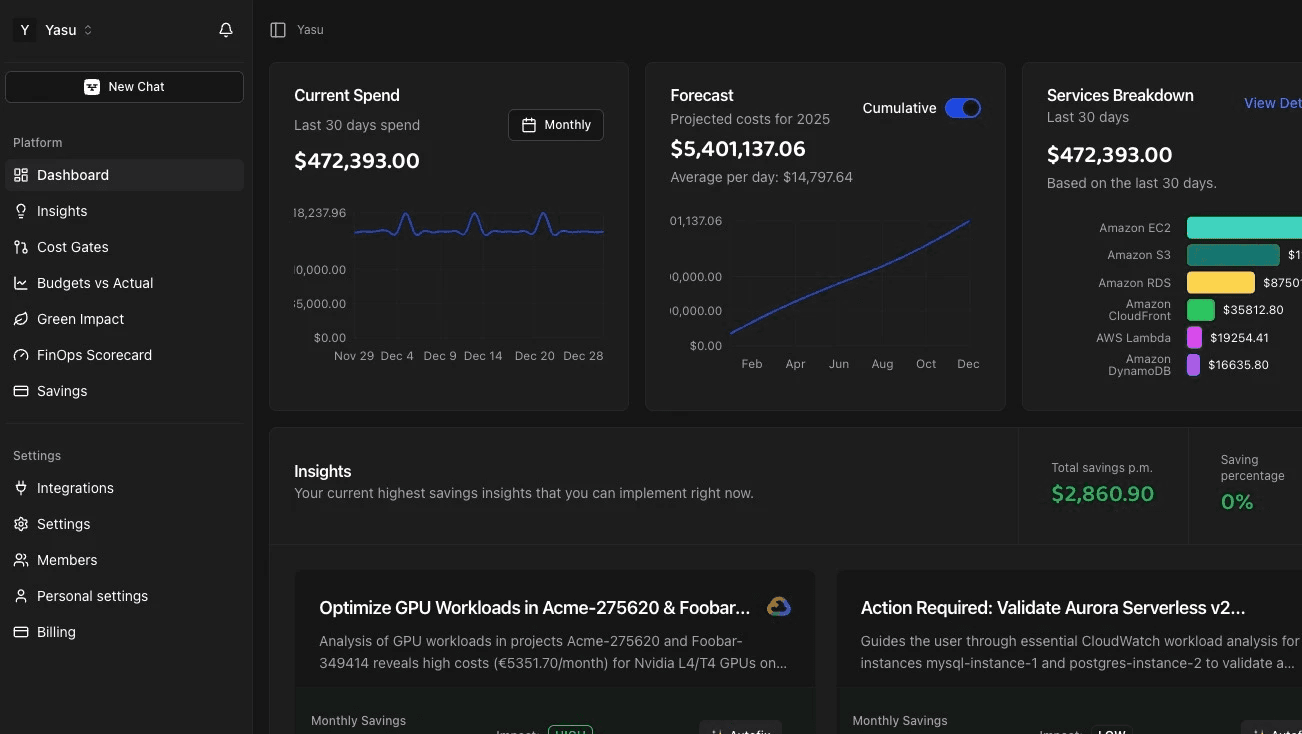
AI-powered cost management platforms like Yasu can automate this monitoring, detecting anomalies against your forecast baseline and identifying the root cause before you need to investigate manually.
Communicating AI Costs to Stakeholders
Different stakeholders need different views of AI cost forecasts.
For the CFO, present total AI infrastructure cost as a percentage of revenue, with quarterly projections and clear scenario ranges. Emphasize unit economics and how cost per unit is trending over time.
For engineering leadership, present component-level breakdowns with capacity planning implications. Highlight where the team needs to invest in optimization versus where costs are already well-managed.
For the ML team, present per-project cost allocations and budget guidelines. Give them clear budgets for experimentation with guardrails that prevent runaway costs without stifling innovation.
The common thread: always present ranges, not point estimates. Stakeholders who understand the inherent uncertainty of AI costs make better decisions than those given a single number with false confidence.
Building Cost Awareness into AI Development
The best long-term forecasting strategy is building cost awareness into your AI development culture. When ML engineers understand the cost implications of their architectural choices, forecasts naturally become more accurate because decisions become more predictable.
Practical steps include showing per-experiment cost reports after each training run, setting per-project GPU budgets with alerts at 70% and 90% utilization, including cost impact analysis in model architecture reviews, and making inference cost per request a tracked metric alongside accuracy and latency.
When cost is visible and owned by the teams generating it, forecasting shifts from a finance exercise to a natural output of informed engineering planning.
Frequently Asked Questions
How far ahead should I forecast AI cloud costs?
Forecast quarterly with monthly granularity. Annual forecasts for AI costs are too speculative to be actionable given how quickly the technology and adoption patterns change. Quarterly forecasts updated monthly strike the right balance between planning horizon and accuracy.
What's a reasonable variance target for AI cost forecasts?
Aim for actuals within 20-30% of your expected scenario during the first six months of an AI initiative, improving to 10-15% as you build historical data. If variance is consistently above 30%, your forecasting model is missing a key cost driver that needs to be identified.
Should I include AI research and experimentation in my cost forecast?
Yes, but as a separate budget category with wider variance bands. Research costs are inherently unpredictable, but they're also real spending that needs to be planned for. Give your ML team a quarterly experimentation budget rather than trying to forecast individual experiment costs.
How do I forecast costs for AI features that haven't launched yet?
Use benchmark-based estimation: profile the model's inference cost per request in a staging environment, then model cost across traffic scenarios. Start with conservative adoption estimates and plan for rapid scaling if the feature succeeds. Having auto-scaling with spend limits in place is more important than accurate pre-launch forecasting.
What tools can help with AI cost forecasting?
Cloud provider cost explorers provide historical data but poor AI-specific forecasting. Specialized platforms like Yasu combine historical cost data with workload behavior analysis and AI traffic patterns to generate more accurate forecasts. The key is a tool that understands AI-specific cost drivers (GPU utilization, model size, batch efficiency) rather than treating all compute the same.