All posts
Insights

John
Every team eventually hits the same uncomfortable question: why is our cloud bill so high? And shortly after that comes the follow-up: which tool should we use to fix it?
The good news is there are solid options. The bad news is they solve meaningfully different problems — and choosing the wrong one for your stage means either paying for capability you don't need yet, or outgrowing a tool six months after you set it up.
This post breaks down three of the most common tools in the terraform cost estimation and cloud cost space: Infracost, Terraform Cloud's built-in cost estimation, and Yasu. We'll map each one to the company stage where it actually shines, so you can make the call with clear eyes.
TL;DR — The One-Line Summary for Each Tool
Infracost: Open-source shift-left cost estimation for developers. Best for small teams who want cost visibility inside their Terraform PR workflow.
Terraform Cloud: Solid cost estimates if you're already paying for HCP Terraform. Not a standalone cost tool — a bonus on top of your IaC platform.
Yasu: AI-driven continuous optimization for teams with real cloud spend. Best for organizations ready to move from awareness to autonomous action.
Stage 1 — The Early-Stage Team (1–20 Engineers)
Infracost is probably your answer
If you're a small team moving fast, Infracost is a natural starting point. It's open-source, integrates directly into GitHub, GitLab, or Azure DevOps pull requests, and does one thing well: it tells you what a Terraform change will cost before you merge it.
A developer opens a PR to resize an EC2 instance or spin up a new RDS cluster, and Infracost drops a comment showing the estimated monthly cost delta. No dashboards to configure, no per-seat pricing to worry about at 8 engineers.
Where Infracost shines:
Zero-to-low budget for tooling
Teams who want cost awareness in code review ("shift-left" FinOps)
Pure Terraform shops on AWS, Azure, or GCP
Developer-first cultures where cost should live next to the code
Where it starts to strain:
Usage-based resource costs (e.g., Lambda invocations, data transfer) require Infracost Cloud, the paid tier
There's no real-time monitoring of running infrastructure — it only covers what's about to be deployed
As team size grows, you need someone to own the workflow and act on the estimates; the tool surfaces the numbers but doesn't close the loop automatically
For teams under 20 engineers without serious cloud spend, Infracost gives you the highest signal-to-noise ratio at the lowest cost.
Stage 2 — The Growth-Stage Team (20–100 Engineers)
Terraform Cloud cost estimation: convenient, but don't mistake it for a cost tool
Once a team grows and standardizes on Terraform Cloud (now HCP Terraform) for state management, remote runs, and access controls, the built-in cost estimation feature comes along for the ride — on the Team and Business tiers.
It's genuinely useful in context. During a Terraform plan, you'll see per-resource hourly and monthly cost estimates, covering the major resource types across AWS, Azure, and GCP. If you're already paying $0.47–$0.99 per managed resource per month for HCP Terraform's collaboration features, this is a low-friction addition to your existing workflow.
Where Terraform Cloud cost estimation shines:
You're already using HCP Terraform and cost estimation is included in your tier
You want cost visibility integrated into your existing run pipeline without a separate tool
Your team is HashiCorp-native and doesn't want to introduce additional vendors
Where it falls short:
Cost estimation is gated to higher (paid) tiers — it's not available on Free or Essentials
It doesn't give you a FinOps dashboard, anomaly detection, or optimization recommendations
It's point-in-time, not continuous — it tells you the cost at plan time, not whether your infrastructure is wasteful right now
No Kubernetes cost breakdown, no idle resource detection, no cross-team allocation
Think of Terraform Cloud's cost features as a useful augmentation, not a cost management strategy. As your infrastructure matures and spend grows, you'll want something that watches the whole picture — not just the next deployment.
Stage 3 — The Scaling Organization (Significant Cloud Spend, 30K€+/month)
Yasu: when you need automation, not more dashboards
At some point, the cost problem changes shape. It's no longer about knowing what things cost — it's about having the engineering bandwidth to actually do something about it. Most teams with meaningful cloud spend already have visibility. What they lack is action.
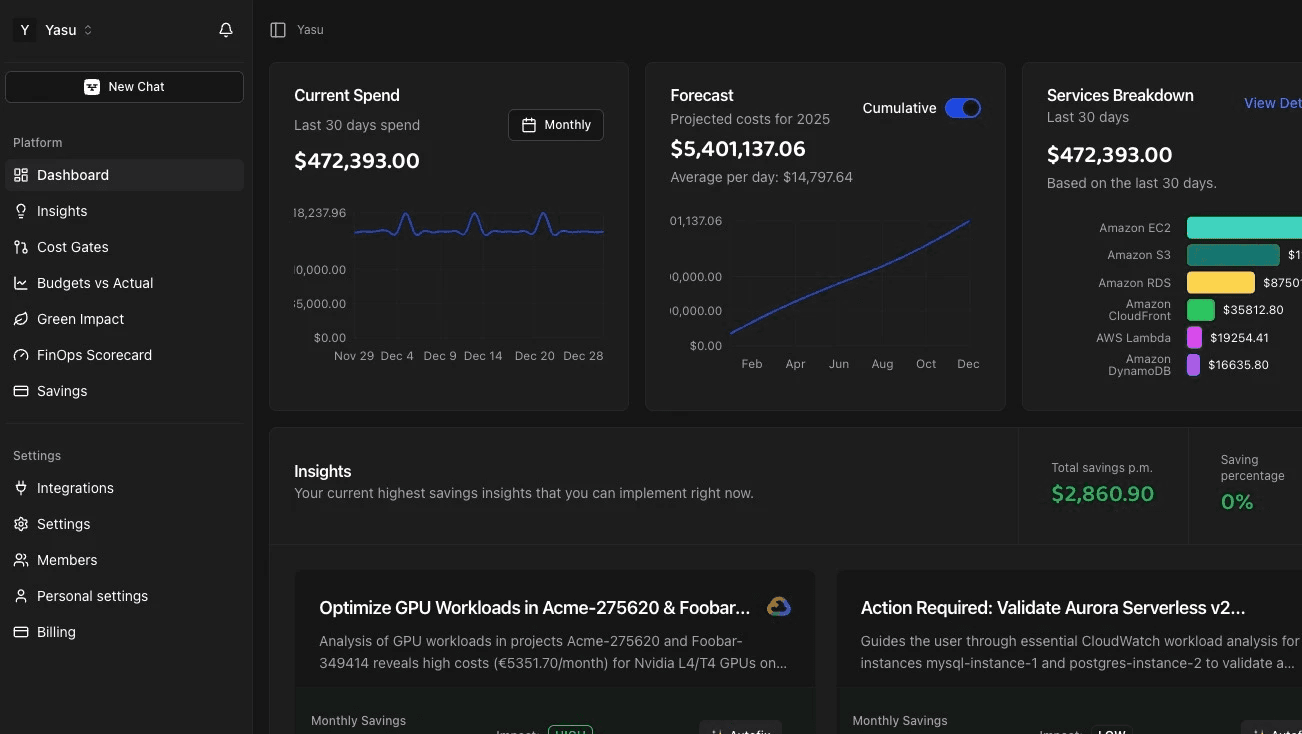
This is where Yasu operates. Rather than adding another dashboard to monitor, Yasu uses AI agents to continuously analyze your infrastructure across AWS, Azure, and GCP — and then act. It integrates directly into Slack and GitHub so engineers see cost intelligence in the tools they already use, and the optimization loop closes without requiring a dedicated FinOps analyst to babysit a UI.
For Kubernetes-heavy teams, Yasu also provides pod- and node-level cost tracking, which is an area where both Infracost and Terraform Cloud cost estimation are effectively blind.
Where Yasu shines:
Teams with €30,000+/month in cloud spend where manual optimization has diminishing returns
Engineering organizations that want autonomous cost reduction — not more alerts
Kubernetes workloads that need granular cost attribution
Multi-cloud environments where a single pane of glass matters
Teams already stretched thin who can't afford a dedicated FinOps function
Where it's overkill:
Early-stage startups with low, predictable cloud spend — the ROI math doesn't work until spend is meaningful
Teams that want full manual control over every optimization decision (though approvals can be configured)
Customers typically see around 35% cost reduction — but the more important number is the engineering hours saved by not having to hunt down waste manually.
Side-by-Side Comparison
Infracost | Terraform Cloud | Yasu | |
|---|---|---|---|
Primary focus | Pre-deployment cost estimation | IaC platform + cost estimates | Continuous AI-driven optimization |
Cost visibility | Before deployment (in PRs) | During Terraform runs | Real-time, ongoing |
Automation | AutoFix PRs (paid) | None | Autonomous optimization agents |
Kubernetes support | Limited | None | Yes, pod/node level |
Multi-cloud | AWS, Azure, GCP | AWS, Azure, GCP | AWS, Azure, GCP |
Pricing model | Freemium (open source core) | Per managed resource/month | Contact for pricing |
Best stage | Early-stage (1–20 engineers) | Mid-stage (already on HCP Terraform) | Scaling teams with real spend |
Slack/GitHub native | GitHub PRs | Via integrations | Native |
How to Choose: A Simple Decision Tree
Start with Infracost if:
You're a small team, you're Terraform-native, and you want cost estimates to show up in your PR workflow without any spend on tooling.
Stick with Terraform Cloud cost estimation if:
You're already paying for HCP Terraform and want cost visibility baked into your existing runs. Don't buy a separate tool for this — but don't mistake it for one either.
Move to Yasu if:
Your cloud spend is significant, your team is stretched, and you're done with dashboards that tell you what's wrong without fixing it. You want the cost loop to close automatically.
Infracost Alternative: What to Look for When You've Outgrown It
If you've been running Infracost and are starting to feel its limits — no real-time monitoring, no Kubernetes visibility, manual follow-up on every estimate — the question isn't whether to replace it but what to replace it with.
The most common trigger is one of these:
Your cloud spend has grown to the point where pre-deployment estimates are no longer your biggest problem
You've hired a platform or DevOps team and need cross-team cost attribution
You're running Kubernetes and Infracost can't give you what you need
Optimization recommendations are piling up with no one to act on them
In each case, the answer is a tool that works post-deployment and continuously — which is exactly the gap Yasu is built to fill.
FAQ
Is Infracost completely free?
The core open-source CLI and CI/CD integration are free. Infracost Cloud — which adds usage-based cost estimation, team dashboards, and policy enforcement — is a paid product with team and enterprise tiers.
Does Terraform Cloud include cost estimation on all plans?
No. Cost estimation is only available on Team and Business tier plans (Standard and above in the newer HCP Terraform pricing). The Free and Essentials tiers do not include it.
Can I use Infracost and Yasu together?
Yes. They operate at different points in the lifecycle — Infracost in your PR workflow before deployment, Yasu continuously on your running infrastructure. Some teams use both, though at the point where Yasu becomes relevant, many find that pre-deployment estimates are less critical than post-deployment continuous optimization.
Does Yasu only work with Terraform?
No. Yasu works across your cloud infrastructure regardless of how it was provisioned — Terraform, CloudFormation, Pulumi, or manually. It connects directly to your cloud accounts (AWS, Azure, GCP) rather than to your IaC toolchain.
What counts as "significant" cloud spend for Yasu to make sense?
As a rough benchmark, teams spending €3,000/month or more on cloud tend to see the strongest ROI. Below that threshold, the savings potential may not exceed the tool cost plus integration overhead — though this varies by how wasteful the current setup is.
Is Terraform Cloud cost estimation accurate?
It covers the most common resource types and gives reasonable estimates for fixed-price resources (e.g., EC2 instance hours, RDS storage). It struggles with usage-based pricing, data transfer costs, and services with highly variable consumption. For those, a dedicated tool will serve you better.
Can Yasu make changes to my infrastructure without approval?
Yasu is configurable — you can run it in recommendation-only mode, require approvals for changes above a certain impact threshold, or enable autonomous optimization for lower-risk actions. Most teams start with approvals and loosen controls over time as they build trust with the system.
What's the best terraform cost estimation approach for a team just starting out?
Infracost in your CI pipeline is the lowest-effort, highest-value starting point. Set it up in an afternoon, and your developers will have cost estimates on every Terraform PR from day one.