All posts
Insights

Vikram Das

Multi-cloud is no longer a strategy debate — it's a reality. Over 85% of enterprises now run workloads across two or more cloud providers, whether by deliberate architecture choices, acquisitions, or teams independently picking the best tool for each job. The cost management implications are massive: three different billing models, three pricing APIs, three sets of commitment instruments, and three completely different ways of naming the same compute resource.
The organizations that manage multi-cloud costs effectively don't try to master each cloud's cost tools independently. They build a unified optimization layer that normalizes spending across providers, identifies cross-cloud arbitrage opportunities, and applies consistent governance regardless of where workloads run.
Why Multi-Cloud Makes Cost Optimization Harder
Single-cloud cost management is already complex. Multi-cloud multiplies that complexity in ways that aren't immediately obvious.
The first challenge is pricing model fragmentation. AWS uses On-Demand, Reserved Instances, and Savings Plans. Azure has Pay-As-You-Go, Reserved VM Instances, and Azure Savings Plans. GCP offers On-Demand, Committed Use Discounts, and Sustained Use Discounts (which apply automatically). Each has different commitment terms, flexibility rules, and discount structures. Comparing the true cost of running the same workload across providers requires normalizing all of these variables.
The second challenge is taxonomy mismatch. An AWS m5.xlarge, Azure Standard_D4s_v3, and GCP n2-standard-4 are roughly equivalent — but their specs, pricing, and available regions differ. Without a translation layer, it's impossible to make apples-to-apples comparisons.
The third challenge is split visibility. Each cloud has its own cost explorer, its own tagging conventions, and its own anomaly detection. Your AWS team might be optimizing EC2 aggressively while Azure blob storage costs quietly triple because nobody's watching that dashboard.
Building a Unified Cost Optimization Framework
Step 1: Normalize Your Cost Data
The foundation of multi-cloud optimization is a single source of truth for spending. This means ingesting billing data from all providers into a unified data model that normalizes instance types to equivalent compute units, maps provider-specific services to common categories (compute, storage, network, database, AI/ML), converts all spending to a single currency with consistent exchange rates, and applies a unified tagging taxonomy across providers.
Without this normalization, you're comparing apples to oranges every time you try to understand your total cloud spend.
Step 2: Implement Cross-Cloud Tagging Governance
Tagging is the backbone of cost allocation, and it's where multi-cloud organizations fail most often. Each cloud has different tagging limits, naming conventions, and enforcement mechanisms.
Establish a mandatory tag schema that works across all providers. At minimum, this should include cost center or business unit, environment (production, staging, development), service or application name, team owner, and data classification. Use infrastructure-as-code to enforce tags at provisioning time, and implement automated compliance checks that flag untagged resources before they accumulate cost.
Step 3: Optimize Commitments Holistically
Most organizations optimize commitments per cloud: they buy AWS Savings Plans, Azure Reserved Instances, and GCP CUDs independently. This siloed approach misses the bigger picture.
A holistic commitment strategy considers the total compute portfolio across all clouds and the flexibility to shift workloads between providers. For example, you might commit deeply to AWS (where 70% of your stable workloads run) while keeping GCP spend mostly on-demand (where you run burst ML training that varies month to month).
AI-powered optimization platforms can model these cross-cloud commitment scenarios, identifying the optimal mix of commitments across providers that minimizes total spend while maintaining workload placement flexibility.
Step 4: Enable Cross-Cloud Workload Placement
The ultimate multi-cloud optimization is placing each workload on the cheapest provider that meets its requirements. A batch processing job might be 30% cheaper on GCP Preemptible VMs than AWS Spot Instances for the same workload profile. An AI inference service might cost less on AWS Inferentia chips than equivalent GPU instances on Azure.
Cross-cloud placement optimization requires understanding the true total cost of each workload (compute, storage, network egress, and data transfer), performance requirements and latency constraints, data residency and compliance requirements, and migration effort and lock-in risk.
AI models can continuously evaluate these factors and recommend optimal placement, turning multi-cloud from a cost liability into a cost advantage.
Common Multi-Cloud Cost Traps
The Data Transfer Tax
Cloud providers charge heavily for data leaving their network. In a multi-cloud architecture where services on different clouds need to communicate, egress charges can become a significant cost center. A service on AWS calling an API on GCP might generate hundreds of dollars in monthly egress fees that nobody notices until the bill arrives.
Map your inter-cloud data flows and consider whether co-locating communicating services on the same cloud would be cheaper than the egress fees of splitting them.
The "Best of Breed" Premium
Choosing each cloud's strongest service (AWS for compute, GCP for ML, Azure for enterprise integrations) sounds smart architecturally but creates operational overhead that has real cost. Each cloud requires separate skills, separate tooling, and separate security configurations. Sometimes the "second best" option on a cloud you already use heavily is cheaper in total cost of ownership.
The Commitment Conflict
Long-term commitments on one cloud reduce flexibility to shift workloads to another. Organizations that over-commit on all three clouds simultaneously can find themselves paying for reserved capacity they can't use because workloads have migrated. Right-size commitments with workload migration plans in mind.
The Role of AI in Multi-Cloud Optimization
AI is particularly valuable for multi-cloud optimization because the decision space is too large for human analysis. Consider just the commitment optimization problem: modeling the optimal mix of AWS Savings Plans, Azure Reserved Instances, and GCP Committed Use Discounts across hundreds of workloads with varying stability and cloud-migration potential creates millions of possible combinations.
AI models can evaluate these combinations in minutes, considering workload stability patterns, commitment discount rates and terms, inter-cloud migration probability, and risk tolerance for commitment utilization.
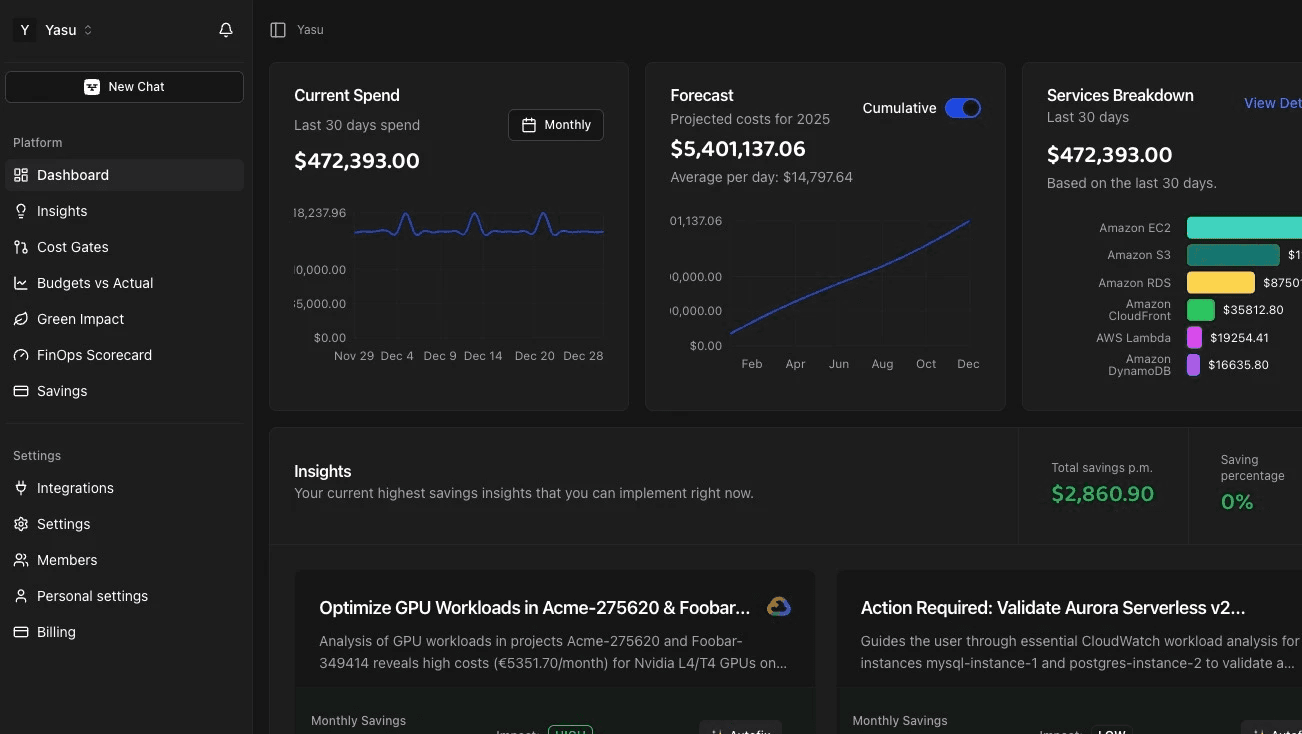
Platforms like Yasu provide this cross-cloud intelligence layer, normalizing data from all providers and applying AI optimization across the entire portfolio rather than cloud by cloud. The result is a unified view of multi-cloud spending with actionable recommendations that consider the full context of your cloud estate.
Measuring Multi-Cloud Optimization Success
Track these metrics across your entire cloud portfolio, not per provider: total cloud spend as a percentage of revenue (should trend downward as you grow), commitment utilization across all providers (target above 80%), cost per transaction or customer across all clouds, waste ratio measured as unused and idle resources divided by total spend, and unit economics by workload type across providers.
The goal isn't to minimize spending on any single cloud — it's to minimize total cloud cost while maintaining the architectural flexibility that multi-cloud provides.
Frequently Asked Questions
Should I consolidate to one cloud instead of optimizing across multiple?
It depends on your situation. If you're multi-cloud by accident (acquisitions, team preferences), consolidation might save more than optimization. But if you're multi-cloud by design (regulatory requirements, best-of-breed services, negotiating leverage), the better strategy is building a unified optimization layer. Most organizations find that a pragmatic middle ground works best: consolidate where possible, optimize where multi-cloud is necessary.
How do I compare costs across clouds when pricing models are so different?
Use normalized compute units (like vCPU-hours) as a common denominator, then add provider-specific costs like networking, storage, and managed services. Several tools and platforms can automate this normalization. The key is comparing total cost of ownership, not just instance pricing.
What's the biggest cost savings opportunity in multi-cloud environments?
Typically, it's commitment optimization. Most multi-cloud organizations either under-commit (paying on-demand prices for stable workloads) or over-commit per cloud (buying reserved capacity they can't fully use because workloads shift). A unified commitment strategy that considers cross-cloud workload mobility usually delivers the largest savings.
How do I handle different tagging systems across clouds?
Implement a cloud-agnostic tagging standard that maps to each provider's system. Use infrastructure-as-code templates that automatically apply the correct tags in each cloud's format. Audit tag compliance weekly and enforce a policy that untagged resources get flagged for review after 48 hours.
Can AI really optimize across multiple clouds simultaneously?
Yes. AI-powered platforms ingest billing and usage data from all providers, normalize it into a common model, and apply optimization algorithms across the full portfolio. This is one area where AI significantly outperforms human analysis, because the combinatorial complexity of multi-cloud optimization exceeds what spreadsheets and manual analysis can handle effectively.