All posts
Insights

Vikram Das
Meta description: Rate vs usage optimization explained. Learn the difference, when to use each, and how to balance both strategies for maximum cloud cost savings.
Introduction
Cloud costs continue to rise, and organizations face pressure to optimize spending without sacrificing performance or innovation velocity. Two core strategies dominate the FinOps landscape: rate optimization and usage optimization. While both aim to reduce cloud spend, they operate through fundamentally different mechanisms and require distinct skill sets, tools, and organizational buy-in.
Rate optimization focuses on negotiating better prices for existing consumption through commitment-based discounts, enterprise agreements, and volume pricing. Usage optimization targets waste reduction by eliminating idle resources, rightsizing overprovisioned infrastructure, and improving application efficiency.
Understanding when to prioritize each approach—and how to balance them—is critical for building a sustainable cloud cost management strategy. This guide explains the differences, explores real-world tradeoffs, and provides a framework for choosing the right strategy for your organization.
What Is Rate Optimization?
Rate optimization means paying less per unit of cloud resource consumed. It's achieved primarily through commitment-based discounts like AWS Savings Plans, Reserved Instances, Azure Reserved Instances, and GCP Committed Use Discounts (CUDs).
How Rate Optimization Works
Cloud providers offer significant discounts (typically 20-70%) in exchange for committing to a specific level of usage over 1-3 years. These commitments can be:
Instance-specific: Reserved for specific instance families/types
Flexible: Applied across instance families or services (like AWS Compute Savings Plans)
Spend-based: Commit to a dollar amount of usage (like GCP Committed Use Discounts)
Key Benefits of Rate Optimization
Immediate savings: Discounts apply instantly once commitments are purchased
Predictable costs: Fixed pricing for committed capacity
No architectural changes: Works with existing infrastructure as-is
Scales with growth: Effective for stable, long-running workloads
Challenges with Rate Optimization
Commitment risk: Over-committing leads to wasted spend on unused capacity
Under-utilization: Purchased commitments that don't match actual usage patterns
Complex management: Tracking utilization, coverage, and renewals across accounts
Rigidity: Hard to adapt to rapidly changing workload patterns
Expertise required: Requires deep understanding of pricing models and usage forecasting
What Is Usage Optimization?
Usage optimization means consuming fewer cloud resources while maintaining or improving performance. It addresses the root cause of cloud waste: overprovisioned, idle, or inefficient infrastructure.
How Usage Optimization Works
Usage optimization identifies and eliminates waste through:
Rightsizing: Matching resource allocation to actual consumption (e.g., downgrading an m5.2xlarge to m5.large)
Idle resource elimination: Shutting down stopped instances, orphaned volumes, unused load balancers
Scheduling: Turning off non-production environments during off-hours
Auto-scaling: Dynamically adjusting capacity based on demand
Architectural improvements: Optimizing code, queries, and data pipelines for efficiency
Key Benefits of Usage Optimization
Addresses root cause: Eliminates actual waste, not just negotiates pricing
No commitment risk: Savings are realized immediately without lock-in
Compounds with rate optimization: Reduces the base consumption rate discounts apply to
Improves performance: Often leads to better application efficiency
Environmental impact: Lower resource consumption reduces carbon footprint
Challenges with Usage Optimization
Requires engineering time: Changes need implementation and testing
Risk of impact: Poorly executed rightsizing can affect performance
Continuous effort: New waste accumulates as infrastructure evolves
Cross-team coordination: Requires collaboration between DevOps, engineering, and finance
Harder to quantify: Savings can be diffuse and difficult to attribute
Rate vs. Usage Optimization: Key Differences
Aspect | Rate Optimization | Usage Optimization |
|---|---|---|
Target | Price per unit | Units consumed |
Method | Commitment discounts | Waste elimination |
Time to savings | Immediate | Varies (days to weeks) |
Risk | Over/under-commitment | Performance impact |
Ownership | FinOps/Finance teams | Engineering/DevOps teams |
Effort | Ongoing management | Continuous optimization |
Savings potential | 20-70% on committed spend | 30-60% on total spend |
Flexibility | Low (commitments lock you in) | High (no long-term commitments) |
Which Strategy Should You Prioritize?
The answer depends on your organization's cloud maturity, growth stage, and operational culture.
When to Prioritize Rate Optimization First
Rate optimization makes sense when:
Stable workloads: Predictable usage patterns over 6+ months
High utilization: Running 70%+ capacity consistently
Limited engineering bandwidth: No time to implement usage optimizations
Mature FinOps practice: You have expertise in commitment management
Large, steady spend: Multi-million dollar cloud budgets with predictable growth
Example scenario: An enterprise SaaS company with 500+ EC2 instances running 24/7 production workloads. Usage is stable and predictable. Savings Plans can immediately reduce spend by 30-40% without any code changes.
When to Prioritize Usage Optimization First
Usage optimization should come first when:
High waste levels: >30% idle resources, oversized instances, or unused services
Rapid growth: Usage patterns changing month-to-month
Dev/staging waste: Non-production environments running 24/7
Early-stage company: Need flexibility to pivot infrastructure
Engineering-driven culture: Teams are empowered to optimize their own resources
Example scenario: A Series A startup with unpredictable traffic patterns, dev environments running 24/7, and 40% of EC2 instances averaging <20% CPU utilization. Usage optimization can cut 40-50% of waste before committing to any pricing model.
The Optimal Strategy: Balancing Both Approaches
The most effective cloud cost management strategies combine both rate and usage optimization in a specific sequence:
Phase 1: Usage Optimization (Months 1-3)
Start by eliminating obvious waste:
Identify low-hanging fruit:
Implement basic automation:
Establish baselines:
Expected outcome: 20-40% reduction in total cloud spend within 90 days.
Phase 2: Rate Optimization (Months 3-6)
Once waste is under control, layer in rate discounts:
Start with flexible commitments:
Target high-utilization workloads:
Monitor and adjust:
Expected outcome: Additional 15-30% savings on top of usage optimization.
Phase 3: Continuous Optimization (Ongoing)
Maintain both strategies in parallel:
Usage optimization:
Rate optimization:
Track combined impact:
Common Mistakes to Avoid
Mistake #1: Committing Too Early
Problem: Buying Reserved Instances or Savings Plans before understanding usage patterns leads to wasted commitments.
Solution: Run for 60-90 days without commitments, analyze usage patterns, then commit to 60-70% of stable workloads.
Mistake #2: Ignoring Usage After Committing
Problem: "We have Savings Plans, so we're optimized." Waste continues to accumulate underneath the discounts.
Solution: Track both committed and on-demand usage. Optimize usage continuously to reduce the base that commitments apply to.
Mistake #3: Optimizing in Silos
Problem: FinOps team manages commitments, engineering team optimizes usage—no coordination leads to suboptimal outcomes.
Solution: Establish cross-functional FinOps meetings. Align commitment strategy with planned infrastructure changes (migrations, re-architectures).
Mistake #4: Focusing Only on Compute
Problem: Most teams over-focus on EC2/VM optimization while ignoring storage, data transfer, and managed services.
Solution: Audit all major cost centers: S3/GCS storage lifecycle policies, data transfer optimization, RDS/database rightsizing, load balancer consolidation.
Mistake #5: Manual Commitment Management
Problem: Spreadsheet-based tracking of Savings Plans and Reserved Instances doesn't scale and leads to errors.
Solution: Use automated commitment management tools (ProsperOps, Vantage, CloudZero) or build automation with cloud APIs.
How Yasu Can Help
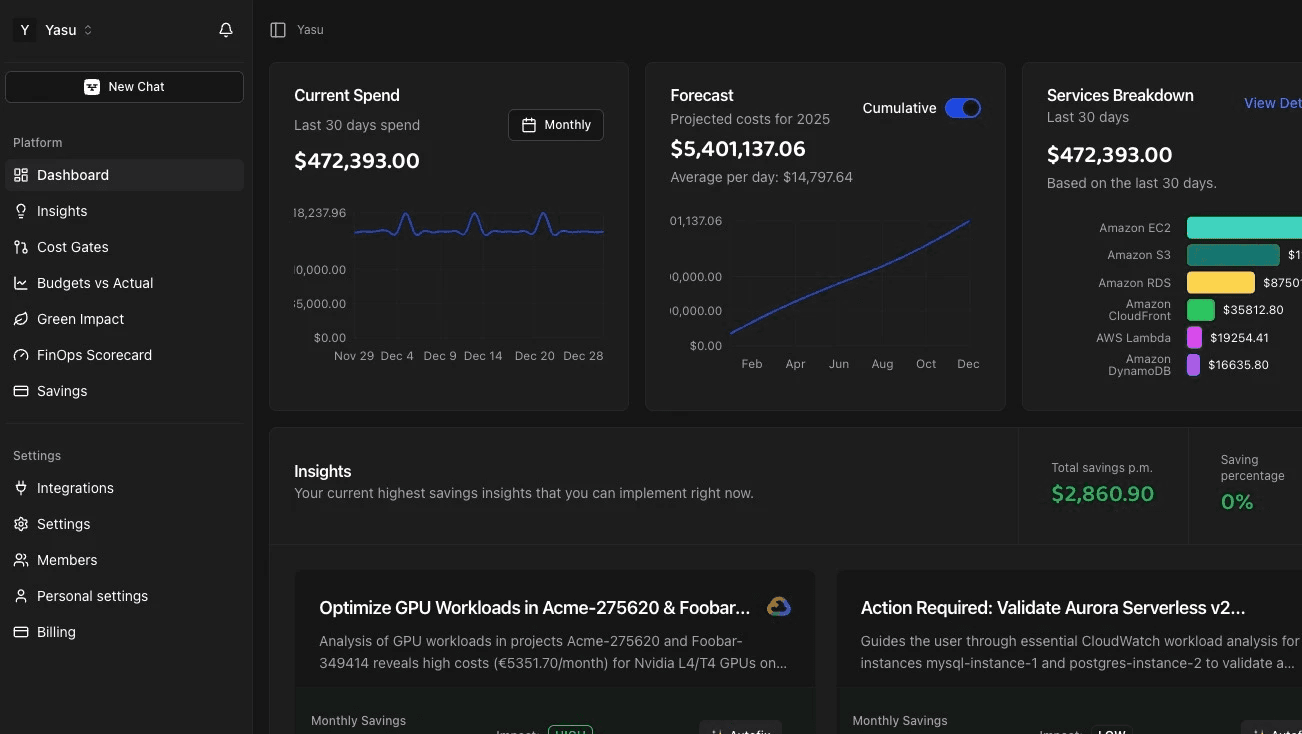
Yasu is an AI-powered cloud cost optimization platform that focuses on runtime usage optimization across AWS, GCP, and Azure.
What Yasu Does
Automated waste detection: Identifies idle resources, oversized instances, and inefficient configurations in real-time
AI-powered recommendations: Provides specific, actionable insights that engineers can implement immediately
Multi-cloud support: Unified visibility across AWS, GCP, and Azure in a single dashboard
Non-technical insights: Translates complex cloud metrics into business-friendly language for finance and executive teams
Continuous monitoring: Tracks optimization opportunities as your infrastructure evolves
Why Start with Yasu
Before committing to long-term pricing agreements, Yasu helps you optimize what you're actually using. This ensures:
You commit to the right amount of capacity (not too much, not too little)
Your baseline spend is lower, maximizing the impact of rate discounts
You maintain flexibility to adapt as your business evolves
Try Yasu free for 14 days → yasu.cloud
Frequently Asked Questions
Q: Can I do rate and usage optimization at the same time?
A: Yes, but it's generally more effective to start with usage optimization first. Eliminate obvious waste (idle resources, oversized instances, non-production sprawl) before committing to long-term pricing agreements. This ensures you're committing to the right capacity level and maximizes the compounding effect of both strategies.
Q: What's the typical savings from rate optimization vs. usage optimization?
A: Rate optimization typically delivers 20-70% savings on the resources you commit to (but only on committed spend, not total spend). Usage optimization typically delivers 30-60% savings on total cloud spend by eliminating waste. Combined, organizations often achieve 40-60% total cost reduction.
Q: Should small startups use Savings Plans or Reserved Instances?
A: Generally no—not in the first 12-18 months. Early-stage companies have unpredictable usage patterns, frequent infrastructure changes, and rapid growth (or contraction). Focus on usage optimization first. Start layering in flexible commitments (like AWS Compute Savings Plans) only once you have 6+ months of stable usage data.
Q: How much time does usage optimization require?
A: Initial cleanup (Phase 1) typically requires 10-20 hours of engineering time over 4-6 weeks. Ongoing optimization requires 2-4 hours per week once automated policies and monitoring are in place. The time investment pays for itself quickly—most teams see 5-10x ROI on engineering time spent optimizing cloud usage.
Q: What if my cloud spend is mostly databases and managed services?
A: Rate optimization is highly effective for databases (RDS, Aurora, Cloud SQL) since they tend to run 24/7 with predictable usage. Usage optimization still applies: review instance sizes, evaluate read replicas, optimize queries to reduce compute needs, and implement automated backups with lifecycle policies. For managed services (Lambda, Fargate, S3), usage optimization is even more critical since commitment discounts are limited or unavailable.
Q: Can automated tools handle both rate and usage optimization?
A: Most tools specialize in one area. Rate optimization tools (like ProsperOps, Zesty) focus on automating Savings Plans and Reserved Instance management. Usage optimization tools (like Yasu, CloudZero, Vantage) focus on identifying waste and providing actionable recommendations. Best practice: use specialized tools for each strategy, and integrate them into a unified FinOps workflow.
Q: What's the biggest risk with rate optimization?
A: Over-commitment. If you commit to more capacity than you use, you pay for the commitment whether or not you use it. This is especially risky during periods of rapid change (migrations, re-architectures, downsizing). To mitigate this risk: (1) Start with 60-70% coverage of stable workloads, (2) Use flexible commitment types (Compute Savings Plans > EC2 Savings Plans > Reserved Instances), (3) Monitor utilization monthly and adjust.
Q: How often should I re-evaluate my optimization strategy?
A: - Usage optimization: Weekly automated checks + quarterly deep dives
Rate optimization: Monthly commitment utilization reviews + quarterly strategic adjustments
Overall strategy: Annually, or whenever major infrastructure changes occur (migrations, re-architectures, significant growth/downsizing)
Q: Does usage optimization impact application performance?
A: It can, if done incorrectly. Safe usage optimization involves: (1) Rightsizing in non-production first, (2) Monitoring performance metrics before/after changes, (3) Using gradual rollouts (e.g., downsize 10% of instances, monitor for 1 week, then scale), (4) Always maintaining headroom for traffic spikes. Tools like Yasu provide recommendations with built-in safety guardrails to minimize performance risk.
Q: What's the ROI of a FinOps team focused on optimization?
A: Organizations with dedicated FinOps teams typically achieve 15-25% annual cloud cost reduction, with the team paying for itself within 3-6 months. For every $1 spent on FinOps tooling and personnel, companies typically save $5-15 in cloud costs. The ROI increases significantly as cloud spend scales beyond $1M annually.
Conclusion
Rate optimization and usage optimization are not competing strategies—they're complementary approaches that work best in sequence and in balance.
Start with usage optimization to eliminate waste, establish baselines, and understand your true capacity needs. Once you have a clean, efficient infrastructure baseline, layer in rate optimization to discount the resources you consistently use.
The organizations that master cloud cost management don't choose between rate and usage optimization. They execute both strategies in parallel, with clear ownership, automated workflows, and continuous monitoring.
Cloud costs will only grow as infrastructure scales. The question is: will you grow costs efficiently, or will waste and over-commitment erode your margins?
Ready to start with usage optimization? Try Yasu free for 14 days and discover how much you can save before committing to any pricing agreements.