All posts
Insights

Vikram Das
FinOps as a discipline is barely a decade old, yet it's already undergoing a fundamental transformation. The first wave of FinOps was about visibility: getting cloud costs out of opaque billing consoles and into dashboards that business stakeholders could understand. The second wave was about process: building organizational muscles around cost review, optimization, and governance.
We're now entering the third wave: AI-native FinOps, where machine intelligence handles the operational work of cost optimization while humans focus on strategy, governance, and business alignment. This shift isn't incremental — it fundamentally changes what FinOps teams do, what tools they use, and how organizations relate to cloud spending.
Here's where cloud cost management is heading, and what it means for organizations planning their FinOps evolution.
Prediction 1: Autonomous Optimization Becomes the Default
Today, most cloud cost optimization is recommendation-driven. A tool identifies that an instance is oversized, generates a recommendation, and a human reviews and implements the change. This model has a fundamental throughput problem: the number of optimization opportunities grows with cloud usage, but the human capacity to review and implement them doesn't.
By 2028, the default operating model will flip. AI agents will autonomously implement the majority of optimizations — rightsizing, commitment management, idle resource cleanup, auto-scaling tuning — with humans reviewing only the exceptions and edge cases.
This isn't speculative. The pattern is already emerging. Organizations using AI-powered platforms that auto-implement high-confidence recommendations see 3-5x higher optimization capture rates than those relying on human-reviewed recommendations. As AI confidence models improve and safety mechanisms mature, the scope of autonomous optimization will expand.
The FinOps team of 2028 won't be implementing optimizations. They'll be defining policies, reviewing AI decisions, and steering strategic cost architecture — more like an executive function than an operational one.
Prediction 2: Cost Intelligence Moves Into the Developer Workflow
FinOps has traditionally been a back-office function: analyze the bill after the fact, then try to fix what's already been provisioned. The future is cost intelligence embedded directly in the developer workflow, at every stage.
In the IDE, AI-powered code assistants will suggest cost-efficient infrastructure configurations as developers write Terraform or Kubernetes manifests. In the PR review, automated cost impact analysis will show the monthly spend implications of every infrastructure change. In CI/CD, policy guardrails will prevent over-provisioning before resources reach production. And in production, continuous optimization will automatically adjust resources based on real-time demand.
This shift-left approach means cost optimization becomes a natural part of building software rather than a separate remediation activity. Developers won't need to become FinOps experts — the intelligence will be embedded in their existing tools.
Prediction 3: FinOps Expands to Cover AI and ML Costs
Traditional FinOps frameworks were built for web applications running on CPU instances with relatively predictable scaling. AI workloads break these models: GPU costs are discontinuous, training costs are bursty and unpredictable, and inference costs scale with model complexity, not just user traffic.
The FinOps framework will evolve to include AI-specific cost categories: training compute, inference endpoints, vector databases, embedding generation, model storage, and data pipeline infrastructure. New unit economics will emerge — cost per inference, cost per training experiment, cost per model version — alongside traditional metrics like cost per transaction.
Organizations that build AI cost management capabilities now will have a significant advantage as AI spending grows to represent 30-50% of total cloud budgets over the coming years.
Prediction 4: Multi-Cloud Optimization Becomes Unified
Today, most organizations optimize each cloud provider independently. AWS gets its own Savings Plans strategy, Azure gets its own Reserved Instance plan, and GCP gets its own Committed Use Discount analysis. This siloed approach misses cross-cloud optimization opportunities.
The future is unified multi-cloud optimization where AI models analyze the entire cloud portfolio simultaneously. This enables cross-cloud workload placement (running each workload on the cheapest provider that meets requirements), holistic commitment strategy (optimizing total commitment spend across providers), and unified governance (consistent cost policies regardless of cloud).
The technical barriers to multi-cloud optimization are dissolving as AI platforms learn to normalize and reason across different provider billing models, pricing structures, and resource taxonomies.
Prediction 5: Real-Time Cost Management Replaces Monthly Reviews
The monthly cloud bill review is an artifact of how cloud billing works, not how optimization should work. By the time you review last month's bill, any waste identified has been running for 30-60 days. The optimization opportunity was there on day one — you just didn't see it until the bill arrived.
Real-time cost management means optimization happens continuously, with sub-hourly detection and response times. An anomalous cost spike at 2 PM gets identified, root-caused, and addressed by 3 PM — not discovered during next month's bill review.
This requires AI-powered monitoring that understands normal spending patterns and can distinguish genuine anomalies from expected variations (like monthly data processing jobs or seasonal traffic patterns). The technology exists today; adoption is the remaining hurdle.
Prediction 6: Sustainability Becomes a First-Class FinOps Metric
As carbon reporting requirements expand globally (CSRD in Europe, SEC climate disclosure rules in the US), cloud carbon emissions will become a mandatory reporting metric. FinOps platforms will integrate carbon tracking alongside cost tracking, providing unified visibility into both the financial and environmental impact of cloud usage.
Optimization algorithms will consider carbon intensity alongside cost, automatically scheduling flexible workloads during periods of high renewable energy availability. The correlation between cost optimization and carbon reduction makes this a natural extension of existing FinOps practices.
Prediction 7: FinOps Platforms Become Agentic
The most significant architectural shift in FinOps tooling is the move from dashboard-centric to agent-centric platforms. Instead of presenting data and recommendations through dashboards that humans monitor, the next generation of platforms will operate as autonomous agents that continuously observe, decide, and act.
These agentic platforms will monitor cloud usage and costs in real time, identify optimization opportunities using machine learning, evaluate the safety and confidence of each potential action, implement high-confidence optimizations autonomously, escalate uncertain decisions to humans with full context, learn from outcomes to improve future decisions, and proactively surface strategic insights that go beyond tactical optimization.
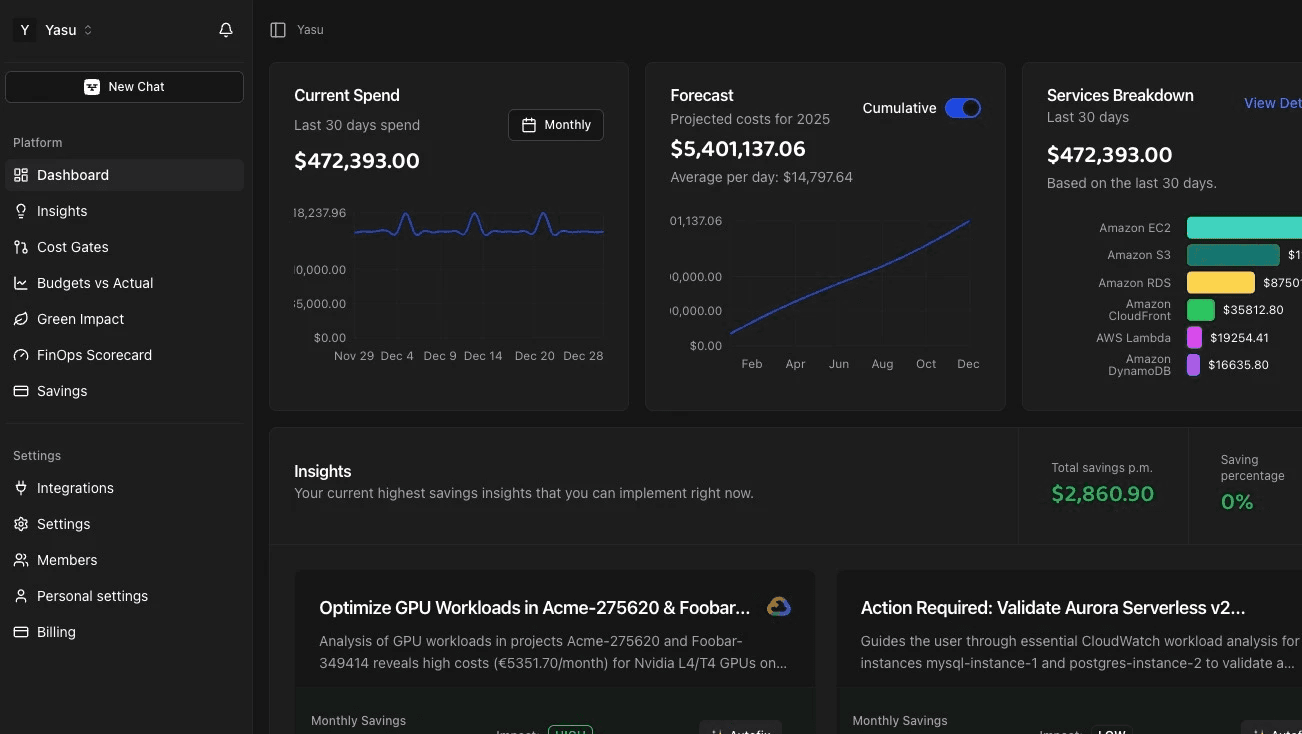
Yasu is building toward this agentic vision: an AI that doesn't just show you where to save money, but actively saves it — with the judgment to know when to act independently and when to ask for human guidance.
What This Means for FinOps Teams
The FinOps role is evolving, not disappearing. As AI handles operational optimization, FinOps professionals will shift toward strategic responsibilities: defining organizational cost policies and standards, evaluating and governing AI optimization decisions, driving cost architecture reviews for new workloads and services, building cost awareness into engineering culture, managing vendor relationships and commercial negotiations, and connecting cloud costs to business outcomes and unit economics.
The FinOps practitioner of 2028 will be more strategist than analyst, more policy architect than spreadsheet builder. The technical barrier to entry will lower (AI handles the complexity), but the strategic value will increase (someone still needs to define what "good" looks like).
Preparing for the Future
Organizations can prepare for AI-native FinOps by taking practical steps today.
Invest in data quality now. AI optimization is only as good as the data it operates on. Clean tagging, accurate cost allocation, and comprehensive visibility are prerequisites for autonomous optimization.
Start automating low-risk optimizations. Build organizational trust in automated optimization by starting with safe, high-confidence changes. Each successful automated optimization makes the next one easier to approve.
Build AI cost management capabilities early. Don't wait until AI is 50% of your cloud bill to figure out how to manage it. Start tracking AI costs separately, establish unit economics, and build optimization practices specific to AI workloads.
Choose platforms built for autonomy. When evaluating FinOps tools, prioritize platforms with AI-native architectures that can grow from recommendations to automation to autonomous optimization — rather than tools that will always require human execution of every change.
The future of FinOps is not more dashboards and more reports. It's intelligent systems that manage cloud costs the way autopilot manages aircraft: handling routine operations autonomously while keeping humans informed and in control of the strategic decisions.
Frequently Asked Questions
Will AI replace FinOps teams entirely?
No. AI will replace the operational tasks that FinOps teams spend most of their time on today (manual analysis, recommendation implementation, report generation), but it will amplify the strategic value of FinOps professionals. The role shifts from execution to governance, strategy, and business alignment — work that requires human judgment and organizational influence.
How soon will autonomous cloud optimization be mainstream?
For specific optimization domains (rightsizing, idle resource cleanup, commitment management), autonomous optimization is already available today from platforms like Yasu. Broad autonomous optimization across all cost categories will likely be mainstream by 2027-2028 as AI confidence models mature and organizations build trust through experience.
What skills should FinOps practitioners develop for the future?
Focus on strategic skills: cost architecture design, business case development, vendor negotiation, organizational change management, and AI/ML cost management. Technical skills in cloud billing and Excel analysis will become less important as AI handles the analytical heavy lifting.
Is the FinOps Foundation framework still relevant in an AI-native world?
The FinOps Foundation's principles (collaboration, business value of cloud, everyone takes ownership) remain highly relevant. The specific practices will evolve as AI changes the execution model, but the cultural and organizational foundations are enduring. Expect the framework to incorporate AI-specific guidance over the coming years.
Should I wait for AI-native tools to mature before investing in FinOps?
Absolutely not. The organizations that will benefit most from AI-native FinOps are those with strong foundations: clean data, mature governance, and organizational buy-in. Start building these foundations now with current-generation tools, and you'll be positioned to adopt autonomous optimization as it matures. Organizations that wait will spend years building foundations while their competitors are already reaping the benefits of AI-powered optimization.