All posts
Insights

Vikram Das

The conversation about cloud cost optimization usually starts and ends with money. Reduce spend, improve margins, make the CFO happy. But there's a dimension to cloud waste that rarely gets the attention it deserves: every wasted dollar in cloud spending represents real energy consumption, real carbon emissions, and real environmental impact. When you're running idle instances, over-provisioned databases, and forgotten development environments, you're not just burning budget—you're burning electricity in data centers that collectively consume more power than most countries. Cloud cost optimization isn't just a finance initiative. It's a sustainability strategy.
The Energy Cost of Cloud Waste
The math is straightforward. Cloud providers bill you for compute capacity, and running that compute capacity requires electricity. An idle EC2 m5.xlarge instance consumes roughly the same power whether it's serving traffic or sitting unused. The cloud provider's data center keeps that server powered, cooled, and networked regardless of your utilization level.
Industry estimates suggest that the average cloud instance wastes 60-70% of its provisioned compute capacity. Applied across global cloud infrastructure, this waste represents hundreds of terawatt-hours of electricity annually — energy that generates carbon emissions without producing any useful output.
For an individual company, the sustainability impact scales with cloud spend. A company spending $100,000/month on cloud infrastructure with typical waste levels is responsible for approximately 25-35 metric tons of CO2e annually from waste alone. That's equivalent to the annual emissions of 5-7 passenger cars driving nothing but empty miles.
How Specific Optimizations Reduce Carbon Impact
Rightsizing
When you rightsize an instance from m5.2xlarge to m5.large (reducing 4x), you're not just cutting your bill by 75%. You're freeing up physical server capacity that the cloud provider can use to serve other customers without powering up additional hardware. In an efficiently run data center, this translates almost directly to reduced energy consumption.
Idle Resource Elimination
Terminating idle instances is the most direct sustainability action in cloud optimization. An idle instance produces exactly zero business value while consuming the same electricity as a fully utilized one. Every idle instance you shut down directly reduces energy consumption.
Auto-Scaling
Proper auto-scaling ensures you run only the capacity you need at any given time. Instead of provisioning for peak demand 24/7, auto-scaling expands during high traffic and contracts during low traffic. The energy savings from running fewer instances during off-peak hours (typically 12-16 hours per day) are substantial.
Commitment Optimization
While commitment purchases (reserved instances, savings plans) don't directly reduce energy consumption, they create financial incentives to consolidate and optimize workloads. Organizations with strong commitment management tend to have better infrastructure hygiene overall, which correlates with lower energy waste.
Spot Instance Usage
Spot instances utilize spare capacity in cloud data centers that would otherwise go unused. By running workloads on spot instances, you're consuming capacity that's already powered and cooled regardless — making use of energy that would otherwise be wasted on the provider's side.
The AI Workload Sustainability Challenge
AI workloads deserve special attention in the sustainability conversation because their energy intensity is orders of magnitude higher than traditional computing.
Training a single large language model can consume as much electricity as 100 US households use in a year. GPU instances used for AI training and inference consume 3-10x more power per instance than equivalent CPU instances. As organizations scale AI adoption, the energy footprint of AI infrastructure becomes a significant sustainability concern.
Optimizing AI cloud costs and optimizing AI sustainability are the same activity. Reducing GPU utilization waste from 70% to 30% doesn't just cut your GPU bill — it cuts the energy consumed by your AI workloads proportionally.
Specific AI sustainability optimizations include using model quantization and distillation to run inference on smaller, less power-hungry instances, implementing inference batching to maximize GPU utilization per watt, scheduling training jobs during periods when the grid has higher renewable energy mix, and shutting down development GPU instances during non-working hours.
Carbon-Aware Cloud Computing
A growing trend in sustainable cloud computing is carbon-aware workload scheduling: running flexible workloads (batch processing, training jobs, data pipelines) during times and in regions where the electricity grid has a lower carbon intensity.
Carbon intensity varies significantly by time of day (more solar during daytime, more wind at night in some regions) and by region (some cloud regions run on grids with 80%+ renewable energy, others are below 30%). By scheduling flexible workloads to run when and where the grid is cleanest, organizations can reduce the carbon impact of their cloud computing without changing their total consumption.
This approach pairs naturally with cost optimization. Cloud pricing often varies by region and time of day, meaning the cheapest times to run workloads frequently correlate with periods of lower carbon intensity (off-peak hours with more renewable energy in the mix).
Making the Business Case for Sustainable Cloud Optimization
For organizations where sustainability is a strategic priority, cloud cost optimization provides a rare opportunity: a sustainability initiative that actually saves money rather than costing it.
This makes cloud optimization an easy sell to leadership teams that are skeptical about sustainability investments. You're not asking for budget — you're freeing it up. Every optimization that reduces waste simultaneously reduces cost and carbon impact.
For ESG reporting, cloud optimization provides quantifiable emissions reduction. Using cloud provider carbon footprint tools (AWS Customer Carbon Footprint Tool, Azure Emissions Impact Dashboard, Google Cloud Carbon Footprint), you can track how optimization activities directly reduce your reported cloud emissions.
For investor relations, demonstrating active management of cloud efficiency signals operational discipline and environmental awareness — both increasingly important factors in technology company valuations.
Building a Sustainability-Inclusive Optimization Practice
Integrating sustainability into your cloud cost optimization doesn't require a separate workstream. It requires adding sustainability metrics to your existing optimization dashboards and processes.
Track carbon alongside cost in your FinOps reporting. Most cloud providers now offer carbon emission data in their billing APIs. Including this metric ensures sustainability benefits are visible alongside financial ones.
Prioritize optimizations with high sustainability impact. When multiple optimization opportunities have similar financial value, prioritize the ones with higher energy reduction — typically GPU and compute optimizations over storage or networking changes.
Set sustainability targets alongside cost targets. If your cost target is 20% waste reduction, add a corresponding carbon reduction target. Since the two are highly correlated, achieving one typically achieves the other.
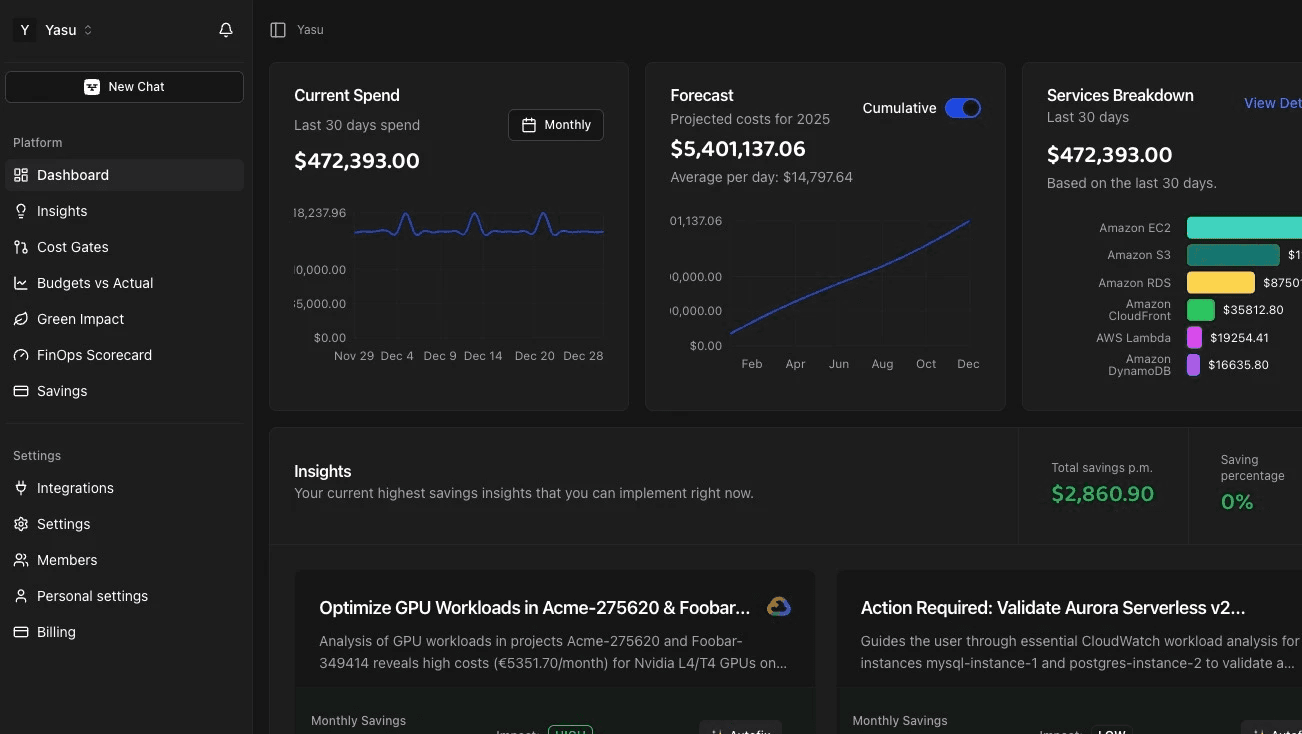
Platforms like Yasu that automate cloud cost optimization are inherently sustainability tools. Every dollar of waste they eliminate represents energy and emissions that are no longer generated for zero value. The continuous, autonomous nature of AI-powered optimization ensures that sustainability improvements happen 24/7, not just during quarterly reviews.
Frequently Asked Questions
How do I measure the carbon impact of my cloud usage?
All three major cloud providers offer carbon footprint reporting: AWS Customer Carbon Footprint Tool, Azure Emissions Impact Dashboard, and Google Cloud Carbon Footprint. These tools estimate the carbon emissions associated with your cloud usage based on the energy consumed and the carbon intensity of the electricity grid in each region where you run workloads.
Does cloud computing produce more or less carbon than on-premises data centers?
Generally less. Cloud data centers operate at higher efficiency (lower PUE) and often source more renewable energy than typical on-premises facilities. However, the ease of provisioning cloud resources can lead to more waste, partially offsetting the efficiency advantage. Optimizing cloud usage is key to realizing the full sustainability benefit of cloud migration.
Which cloud provider is the most sustainable?
Google Cloud has matched 100% of its energy consumption with renewable energy purchases since 2017. Azure has committed to 100% renewable energy by 2025. AWS is targeting 100% renewable energy by 2025. All three are making significant investments in sustainability, but the carbon intensity of your specific workloads depends more on the regions you use than the provider you choose.
Can I reduce emissions by moving workloads to cleaner cloud regions?
Yes, significantly. The carbon intensity of electricity varies by a factor of 5-10x between cloud regions. Moving a workload from a coal-heavy grid region to a renewable-heavy region can reduce its carbon footprint by 70-80%. However, this must be balanced against latency requirements and data residency regulations.
Is there a conflict between cost optimization and sustainability?
Almost never. Cloud cost optimization and sustainability are highly aligned because both are achieved by reducing unnecessary resource consumption. The rare exception is when cost optimization involves moving workloads to cheaper regions that have higher carbon intensity — a trade-off worth evaluating explicitly when it arises.